When comparing stainless steel vs. aluminum railing systems, powder-coated aluminum is the practical choice for most Toronto and GTA homes, decks, porches, and balconies. It costs less, weighs less, and resists rust. Stainless steel is ideal for slim cable or glass-clip designs, a natural metal finish, and demanding conditions where durability matters. Ontario winters make this decision different from choosing railings in a sunny or marine climate. Road salt and freeze-thaw cycles pose the main challenges. Whichever material you choose, the quality of the finish, fasteners, and installation matters as much as the metal itself.
Stainless Steel vs. Aluminum Railing Systems in Ontario: A Practical Guide for Toronto and GTA Homeowners
Either metal can meet the Ontario Building Code. Compliance depends on how the system is designed and installed, not on the metal alone.
What Ontario Weather Does to Railing Metal
Most railing advice online comes from US companies, and much of it is written for coastal buyers. That advice does not translate directly to the GTA.
Lake Ontario is fresh water. The salt-spray guidance that manufacturers give for ocean-front homes does not map neatly onto Toronto, Oakville, or Hamilton. That is my reading of the guidance, so confirm with your supplier. The exposure that matters in Ontario is winter de-icing salt: splash from roads, salt tracked onto steps and porches, and salt scattered on your own walkway.
Chloride salts do corrode metal. A Corrpro Canada study for the City of Edmonton found that carbon steel corroded most easily, stainless steel resisted best, and aluminum, zinc, and carbon steel can all corrode when exposed to chloride de-icers. Testing in Canada is ongoing. One Western University project is comparing how different road salts affect samples of steel, stainless, and aluminum alloy, and the research is still in progress.
Railing manufacturers flag de-icing salt too. Feeney, a railing maker, recommends extra protection in areas with frequent winter de-icing salt use.
Freeze-thaw and temperature swings stress joints and coatings. Aluminum expands and contracts more than stainless steel with temperature (roughly 1.4 times more, going by standard material data). Good installers allow for this movement. Poor installs can leave loose rails or cracked finish at connections.
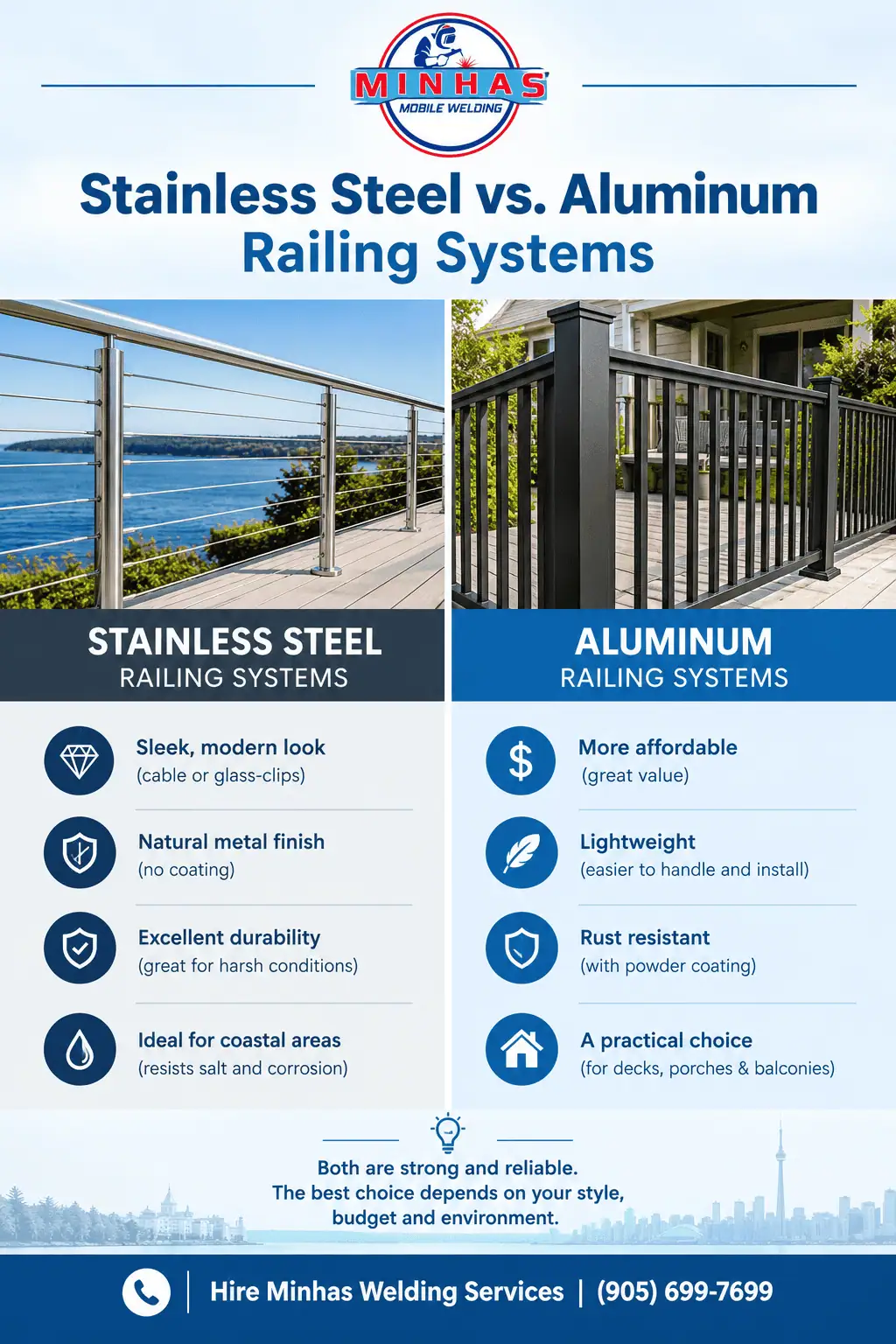
Stainless steel railings explained
Stainless steel is an iron alloy with chromium, which forms a protective surface layer. Two grades matter for railings.
304 stainless works well indoors and in many outdoor settings. Grade 304 suits outdoor use where chlorides are not present, but it is not the right pick for harsh salty environments.
316 stainless adds molybdenum. That improves resistance to chloride pitting, which is why 316 is preferred in marine and coastal settings. It is still not completely corrosion-proof.
What this means in the GTA: 304 is common and often fine for covered porches and many residential railings. If the railing sits near a driveway, a salted walkway, or a pool, 316 is the safer specification. It costs more, so confirm the grade in writing. Some products are sold simply as “stainless” without stating the grade.
Stainless can still stain. One manufacturer’s care sheet notes that stainless steel can show corrosion in contaminated environments such as pools and chemical-heavy areas, even in 316. Regular rinsing with fresh water removes salt and grime before they cause marks.
Strengths:
- High strength and stiffness, so thin posts and slim cable systems are practical
- The finish is the metal itself, with no coating to chip
- Good fit for modern designs
Limits:
- Higher cost
- Heavier to handle
- Polished surfaces show fingerprints and water spots
Aluminum railings explained
Railings are made from extruded sections, typically with a powder-coated finish in black, bronze, white, or custom colors. Aluminum does not rust. The powder coat adds color and extra protection.
The coating is the part to examine. Powder coat quality varies widely. Finish standards from the American Architectural Manufacturers Association (AAMA) rate performance, and AAMA 2604 and 2605 are the two most often cited. Warranties vary too. One manufacturer publicly lists a 1-year exterior warranty on its standard powder coat and 10 years on its fluoropolymer powder coat. Treat that as one example, not an industry rule. Ask your supplier for the written coating warranty and what voids it.
Maintenance is light but not zero. Care guidance from one aluminum railing maker calls for cleaning at least twice a year with mild soap and water, plus checking fasteners for loosening. It also notes that the powder coat can develop a white chalky film with age. The film is normal and can be cleaned off.
Strengths:
- Lower purchase price
- Lightweight and easier to install
- Wide choice of colors and picket styles
- Does not rust
Limits:
- Less stiff than steel, so post spacing and anchoring need careful design
- Chips in the coating should be touched up promptly
- Color can fade over time on lower-grade coatings
Mixing metals: a hidden risk
Many railings pair aluminum posts with stainless cable or hardware. This is common and works, but dissimilar metals in contact can react when salt is present. Feeney warns that this reaction can leave unsightly oxidation stains, and that isolation pads between aluminum parts and mounting surfaces help prevent it.
Ask your installer whether the system isolates dissimilar metals and which fasteners it uses. Stainless fasteners are standard with aluminum, but they should be inspected every year.
Side-by-side comparison
| Factor | Stainless steel | Powder-coated aluminum |
|---|---|---|
| Rust resistance | Strong; grade matters (316 for salty exposure) | Does not rust; coating protects against corrosion |
| Road salt tolerance | Good; rinse regularly | Good while the coating is intact |
| Strength and stiffness | Higher | Lower; engineered spacing matters |
| Weight | Heavier | Lighter |
| Finish options | Brushed or polished metal | Many colors and textures |
| Typical upkeep | Rinse, wipe, remove staining | Wash, touch up chips, check fasteners |
| Upfront cost | Generally higher | Generally lower |
| Best fit | Cable, glass, modern designs; harsher exposure | Decks, balconies, porches; budget-conscious projects |
Ontario Building Code: what applies to your railing
The Ontario Building Code (OBC) regulates guards on decks, porches, and balconies. The details below come from municipal guides based on the code. Confirm the current edition and local amendments with your municipality before you order.
When a guard is needed. Municipal guidance generally ties guard requirements to a drop of more than 600 mm (about 2 feet). Guelph’s guidance, for example, requires a building permit for decks with the floor higher than 0.6 m.
Guard height
Municipal guidance states a minimum guard height of 900 mm where the deck surface is under 1.8 m above grade, and 1,070 mm above that height. Stairs have separate rules for guard and handrail heights.
Openings
Guards must prevent the passage of a 100 mm (4-inch) sphere. This matters for picket spacing and for cable railing, where cables are thin and the gap is easy to exceed under load. Ask your installer how the system keeps cable spacing compliant.
Climbability
The code says guards should not have members or openings between 140 mm and 900 mm above the walking surface that make climbing easier. Kitchener’s guide notes that a guard with spaces no larger than 45 mm wide by 20 mm high is considered not to facilitate climbing. Horizontal cable runs are a common point of review, so ask how the product addresses this.
Strength
The OBC sets load requirements for guards. This is a main reason to buy an engineered system. Ask for documentation showing the system meets code, and do not rely on appearance.
Permits in Toronto
The City of Toronto says deck and porch permit applications go through Toronto Building’s online Express portal. Applications must include guard construction details, such as openings and climbability, along with guard locations. Some detached decks may not need a permit. Rules in Mississauga, Brampton, Vaughan, Markham, and other GTA municipalities differ in the details, so check yours.
Pool areas
If your railing is part of a pool enclosure, separate by-laws may apply. In one Toronto staff report, a metal balcony guard at 1.15 m was reviewed against a 1.2 m requirement under the Toronto Municipal Code’s swimming pool enclosure chapter. Confirm the pool by-law before you finalize a height.
Condos. If you live in a condominium, ask your property manager or board about rules for exterior railings before you replace anything. Many corporations have approval requirements.
How to compare costs without guessing
Prices vary by grade, finish, infill, height, and site conditions, and I have not published figures I could not verify. Instead, compare quotes on these points:
- Material and grade in writing (304 or 316; alloy and coating spec for aluminum)
- Infill type (pickets, cable, glass), which often drives cost more than the posts
- Hardware and fasteners, including stainless grade and isolation between metals
- Coating or finish warranty, and the conditions that void it
- Installation, permit, and engineering costs, and who handles them
- Ongoing upkeep over 10 to 15 years
A cheaper railing with a short coating warranty can cost more over time than a pricier one that lasts.
A realistic Ontario maintenance routine
- Early spring: Rinse thoroughly to remove winter salt. Inspect for chips, loose posts, and fastener corrosion.
- Summer: Wash with mild soap and water. Touch up any coating damage.
- Late fall: Clean again before freezing weather. Check base plates and caulking.
- During winter: Brush or rinse salt off the lower rails near walkways when you can.
Avoid abrasive pads and harsh cleaners. They can damage powder coat and scratch stainless.
Which railing fits which Ontario property?
- Rear deck on a detached or semi-detached home: Powder-coated aluminum is usually the cost-efficient choice, and it suits most color preferences.
- Condo balcony: Check board rules first. Aluminum with glass or pickets is common. Stainless suits a modern look.
- Lakefront property (Lake Ontario, Georgian Bay, Muskoka): Fresh water is less corrosive than seawater, but sun, ice, and splash still apply. Prioritize a quality coating or 316 stainless.
- Front steps or driveway-adjacent railing: This is where salt exposure is highest. Consider 316 stainless or a high-performance coating, and plan on regular rinsing.
- Pool-adjacent railing: Pool chemicals add corrosion risk. Favor 316 stainless or a high-performance coating, and confirm by-law heights.
- Modern cable or minimal glass design: Stainless posts handle slim profiles well. Ask about code-compliant cable spacing.
Common mistakes to avoid
- Buying on photos instead of written specs for grade, alloy, and coating
- Assuming “stainless” means maintenance-free
- Skipping the permit check for decks and porches
- Mixing metals without isolation
- Ignoring the warranty fine print
- Choosing infill before confirming code compliance
Questions to ask a railing contractor
- Which stainless grade or aluminum coating spec do you use?
- Is this system engineered or tested for Ontario Building Code loads?
- How does the design meet the 100 mm opening and climbability rules?
- Who pulls the permit, and are you familiar with my municipality’s process?
- What is the written warranty on the finish and the structure?
- How do you isolate dissimilar metals and what fasteners do you use?
- What does the manufacturer say about de-icing salt exposure?
Ready to choose a railing for your home?
If you’re weighing stainless steel against aluminum for a deck, porch, balcony, or staircase in the GTA, Minhas Welding and Fabrication Services can help you compare options for your property. Share your project details, such as the height, the location, and the look you want, and we’ll talk through which material and finish suit your site and the Ontario Building Code requirements that apply.
Contact us to request a free estimate or to discuss your railing project.
Bottom line
Choose powder-coated aluminum if you want good value, color options, and low maintenance for a typical deck or porch. Choose stainless steel if you want strength, slim profiles, and a metal finish, and specify 316 for salt-exposed spots. Verify code compliance and permits before you buy.
Frequently Asked Questions
Is stainless steel or aluminum railing better for Ontario winters?
Both work. Stainless resists corrosion in the metal itself, while aluminum relies on its coating. In high-salt spots, 316 stainless or a premium coating is safer.
Does aluminum railing rust?
No. Aluminum does not rust, though it can corrode if the coating is damaged and salt reaches the metal.
Is 304 stainless okay for a Toronto deck?
Often yes, especially for covered or low-exposure areas. Near driveways, salted walkways, or pools, 316 is the safer choice.
Do I need a permit to replace my deck railing in Toronto?
It depends on the work and the deck. Toronto reviews guard details as part of deck permits, and some work may not need one. Confirm with Toronto Building or your local municipality before starting.
What height must a deck guard be in Ontario?
Municipal guidance based on the OBC lists 900 mm for walking surfaces up to 1.8 m above grade and 1,070 mm above that. Confirm for your project.
Which costs less over time?
Aluminum usually costs less upfront. Total cost depends on coating warranty, exposure, and upkeep, so compare long-term quotes.
Can I mix stainless cable with aluminum posts?
Yes, it is a common pairing. Ask how the manufacturer isolates the metals and which fasteners it uses.