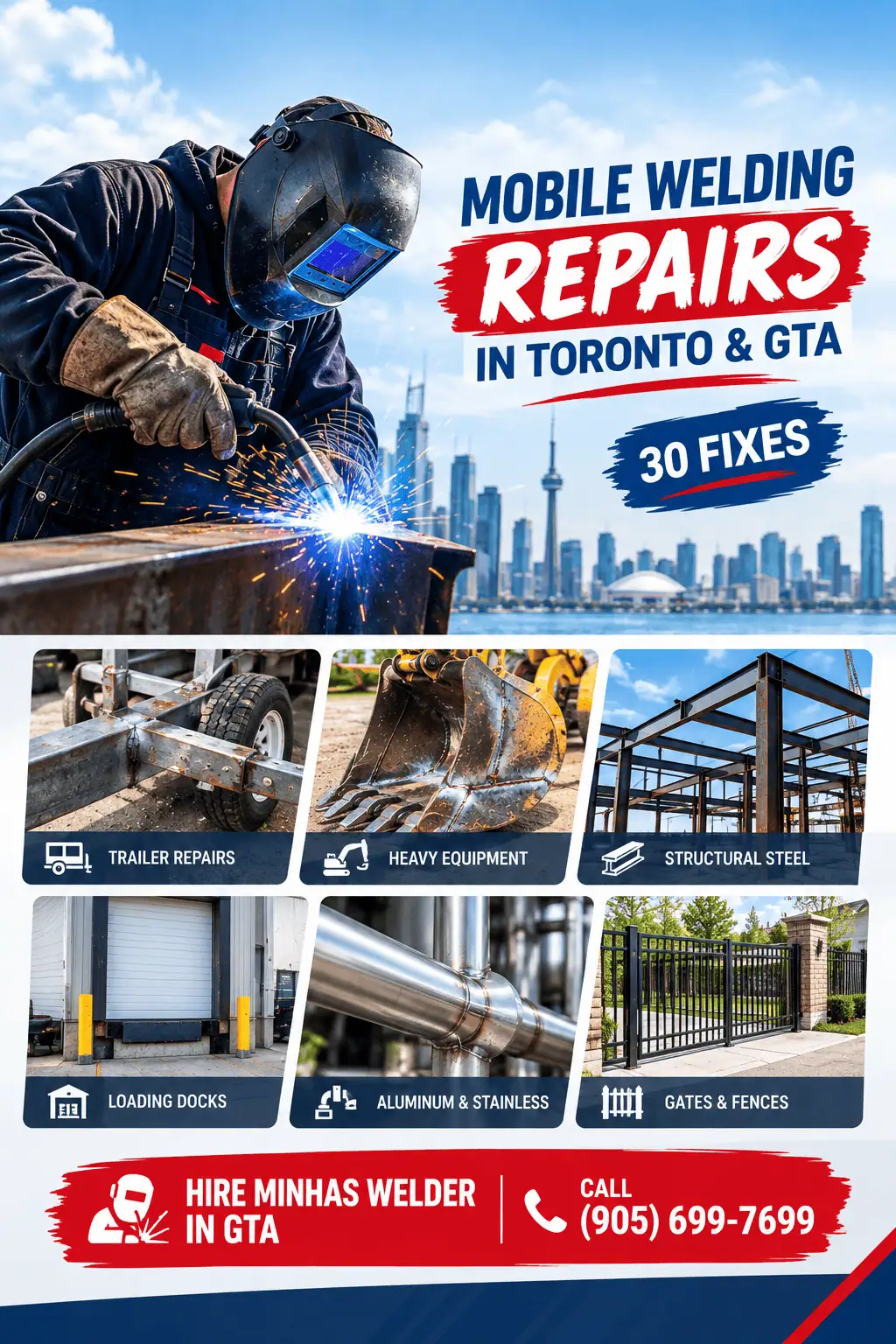
Mobile Welding Repairs in Toronto & GTA: 30 Fixes

30 Fixes Mobile Welding Can Repairs in Toronto & GTA

A cracked equipment bracket. A trailer frame split down the rail. A gate hinge that finally gave out, or a guardrail bent flat by a forklift. Any one of these can shut down a yard for the day, especially when the broken piece is too big, too heavy, or too awkward to drag onto a flatbed and haul into a shop.

That’s the gap mobile welding fills for contractors and fleet managers across the GTA. Instead of loading a disabled trailer onto another trailer just to move it, a mobile welder shows up with the machine, the power source, and the know-how already in the truck.

Across Toronto and the surrounding region, mobile welding repairs cover everything from trailers and trucks to heavy equipment, industrial machinery, gates, structural steel, farm equipments, aluminum and stainless parts, piping supports, safety barriers, and the occasional 2 a.m. emergency. But not everything on that list should actually get welded on-site, and this guide walks through why.

What Is Mobile Welding?

Mobile welding means the welding trucks  rigs and the technician travel to the broken part, wherever it happens to be sitting, instead of the part traveling to a shop. The welding process itself doesn’t change much.

Mobile welding is on-site metal repair, cutting, and fabrication carried out with portable equipment brought straight to a vehicle, structure, or piece of equipment. It skips the step of hauling that item into a fixed shop. The technician and the tools come to the job instead.

What changes is the setting. On-site work has to account for accessibility, ventilation, weather, fire risk, and whether the area around the repair can actually be secured while sparks are flying.

A mobile welder Toronto crews call out for a cracked dock plate is working under completely different conditions than a shop tech standing under a fume hood. Every single job, no matter how big or small, comes back to one practical question: can this specific repair be safely reached, prepped, welded, and checked over right where it sits?

30 Mobile Welding Repairs a Welder Can Potentially Handle On-Site

When equipment, structures, or metal components fail on-site, moving them to a welding shop is not always practical. Mobile welding repairs can often be completed where the problem occurs, saving time, reducing downtime, and avoiding transport costs.

From gates and fences to trailers, machinery, docks, and structural components, here are 30 mobile welding repairs a welder can potentially handle on-site, depending on the damage, access, and repair requirements.

1. Mobile Welding for Broken Trailer Frames

Frame rails split from overload, fatigue, or plain old rust. A welder traces the crack back to its cause, checks how far it’s spread, then repairs or reinforces that section before the trailer goes back to work.

2. Trailer Ramp Welding & Repairs

Ramps absorb a beating every time something heavy rolls up or down them. Worn hinges, cracked brackets, and torn attachment points are usually fixable once the ramp is propped up and secured properly.

3. Dump Trailer Welding Repairs

Hoist mounts, hinge pins, and tailgate brackets crack from thousands of loading cycles. Before any welding starts, though, a loaded or unstable dump trailer needs to be locked down first.

4. Truck Body Welding Repairs

Box panels, brackets, and support rails on service trucks often just need a patch or some reinforcement, not a week off the road.

5. Heavy Equipment Frame Repairs

A crack in a heavy equipment frame changes how load travels through the whole machine. Load-bearing sections sometimes need engineering input before a torch even gets lit.

6. Excavator Bucket Welding Repairs

Cutting edges, tooth mounts, and bucket walls wear thin after enough digging. A mobile welder can rebuild those worn edges right on the site, no flatbed required.

7. Skid Steer Welding Repairs

Loader arms, mounting plates, and attachment brackets take a constant pounding. Cracks near pivot points show up often and are common repair candidates.

8. Forklift Welding Repairs

Guards and non-load-bearing brackets are usually field-repairable. Forks and mast components carry a different level of risk, though, and typically need a closer look first.

9. Conveyor Frame Welding Repairs

Support legs and mounting brackets crack under constant vibration. Fixing the conveyor frame in place beats tearing apart an entire production line.

10. Broken Gate Welding Repairs

Gate frames crack at their welded joints, and hinges pull loose from posts over time. Most gate and fence repairs happen with the gate propped up and held secure.

30 On-Site Welding Repairs That Can Save You a Trip to the Shop

11. Commercial Door Welding Repairs

Steel door frames, hinge plates, and closer brackets wear down fast under heavy foot traffic. Repairing them on-site gets an entry back in service without much delay.

12. Loading Dock Welding Repairs

Dock plates, bumper brackets, and leveler frames absorb impact every single day. A damaged loading dock area should stay out of service until someone’s assessed it.

13. Stair & Handrail Welding Repairs

A loose handrail post or a cracked stair stringer isn’t a cosmetic problem, it’s a safety one. Any repaired system should be checked over before people start leaning on it again.

14. Structural Steel Crack Repairs

A crack in structural steel is rarely a simple welding job. It calls for figuring out the cause, proper prep work, and often an engineering review plus inspection afterward.

15. Steel Beam Reinforcement

Some beams need added plates or stiffeners to handle the loads they’re carrying now. Deciding how to reinforce them is an engineering call, guided by applicable codes.

16. Column Reinforcement Welding

Damaged columns sometimes need welded joist reinforcement too. Since columns carry a building’s weight, that decision hinges on confirmed load conditions and engineering review, not guesswork.

17. Equipment Bracket Welding

One broken mounting bracket can stop an entire machine or conveyor cold. These small fabricated parts are usually quick to rebuild right on-site.

18. Machinery Frame Welding

Cracked welds and fatigued frame sections show up often on production machinery. Repairing them in place skips the long process of disconnecting and reinstalling everything.

19. Agricultural Equipment Welding

Plows, seeders, and wagons break welds and crack brackets, usually at the worst possible time mid-season. Repairing them right on the farm beats hauling an awkward load anywhere.

20. Farm Trailer Welding

Farm trailers take a beating from rough terrain, showing up as frame damage, ramp problems, and failed hinges. On-site repair keeps them working without ever leaving the property.

21. Fence & Gate Hinge Welding

Hinge welds fail, and mounting plates tear loose from posts over time. These repairs are usually straightforward once the gate is properly supported.

22. Aluminum Trailer Welding

Aluminum demands alloy identification, careful surface prep, and heat control that steel doesn’t need. Rush a weld on an aluminum trailer and you’ll compromise the whole joint.

23. Aluminum Equipment Repairs

Aluminum frames, brackets, and housings can be repaired on-site as long as the alloy and joint design get identified correctly beforehand.

24. Stainless Steel Equipment Repairs

Stainless equipment in food-service and industrial settings needs careful cleanliness and tight heat control to keep its corrosion resistance intact.

25. Pipe Support Welding

Hangers and supports around piping are usually repairable on-site. Welding directly on pressurized or active piping is a different job entirely, with its own precautions.

26. Pipe Rack Repairs

Damaged pipe-rack frames and support brackets change how the piping above them gets loaded. Structural conditions need a review before any repair work starts.

27. Warehouse Rack Repairs

A bent rack upright isn’t automatically an easy weld fix. Rack systems often call for manufacturer guidance, inspection, or flat-out replacement instead.

28. Industrial Guardrail Repairs

Bent posts and broken brackets on guardrails undercut the protection they’re supposed to provide. Damaged sections need assessment before anyone puts them back into use.

29. Safety Barrier Welding

Bollards and barriers are designed to absorb impact. A repair should bring back that protective function, not just make the barrier look fine again.

30. Emergency Metal Repairs

Metal failures on fleet, construction, farm, or warehouse equipment tend to happen without warning and stop operations dead. Emergency mobile welding means someone can assess and repair on-site where that’s the right call.

When Is On-Site Welding Better Than Shop Welding?

There’s no fixed rule here, it depends on the specific repair in front of you. The table below covers situations mobile welders around Toronto and the GTA run into regularly, and where on-site work tends to make sense compared to when a shop is still the better call.

Situation Mobile Welding Shop Welding
Large equipment cannot be transported Strong option Less practical
Emergency breakdown Often useful May cause transport delays
Small removable component Sometimes unnecessary Often practical
Large structural repair May be suitable after assessment May be preferred depending on scope
Remote equipment Strong option Transport required
Controlled fabrication Less suitable Strong option
Complex machining required Limited Better suited

What Should You Tell a Mobile Welder Before They Arrive?

A clear description upfront lets a welder figure out whether a job is realistically suited to on-site work before a truck even leaves the yard.

Useful details include the type of equipment or structure, the location, the material if you know it, photos of the damage, rough dimensions, how it happened, whether the equipment still runs, whether the damaged part carries a load, any access limitations, your timing needs, and any safety restrictions on-site.

Photos paired with an accurate description usually tell a welder more than a phone call ever could.

When a Welding Repair Needs More Than Welding

Welding is frequently just one piece of a full repair. Depending on the job, the work might also call for engineering assessment, replacement parts, machining, extra fabrication, nondestructive testing, formal inspection, manufacturer specs, load testing, applicable codes and standards, or additional surface prep.

This shows up most with load-bearing frames, structural steel, columns, beams, safety barriers, and storage racks. A mobile welder who flags these needs before picking up a torch isn’t dodging the job. They’re telling you what an actual, lasting repair requires.

Why Choose Minhas as Mobile Welding in Toronto & the GTA?

For fleet operators, contractors, and industrial facilities across the region, the case for mobile welding is pretty simple. Equipment stays put instead of getting loaded and hauled somewhere, transport costs disappear, and downtime shrinks because the repair happens wherever the equipment already sits.

Construction sites, farms, warehouses, and industrial yards all get reached directly, no detour required. And when a breakdown hits without warning, getting a mobile welder out to assess things on-site usually beats arranging a tow or transport first.

The Bottom Line

A mobile welder can potentially fix a lot more than a broken gate or a split trailer frame. The range stretches from trailers and trucks to heavy equipment, machinery, industrial structures, farm equipment, aluminum and stainless parts, safety barriers, and the occasional emergency failure.

The real question isn’t whether something can technically be welded. It’s whether that specific repair can be safely and properly assessed, prepped, welded, and inspected right where it’s sitting.

Need Welder? We’ve Got You Covered!

When a metal component breaks, cracks, or needs reinforcement, you may not need to transport the equipment to a welding shop. A mobile welder can often bring the tools and equipment directly to your location, helping reduce hauling, delays, and unnecessary downtime.

From trailer and heavy equipment repairs to structural steel, gates, loading docks, and custom metal work, Minhas Mobile Welding provides on-site welding solutions across Toronto and the GTA. If you’re unsure whether your repair can be handled on-site, reach out to discuss your project and find the right welding solution. Call (905) 699-7699, or contact us today, 24×7 available.

Frequently Asked Questions

Can a mobile welder repair a broken trailer frame?

Yes, in many cases, once someone’s assessed the crack’s cause and how far it’s spread. Bigger structural sections or repeat failures might need shop-level fabrication or an engineering review instead.

Does every damaged metal component need to be removed before welding?

No, not usually. Plenty of brackets, gates and fences, and supports can be repaired right where they are, though load-bearing or safety-critical parts sometimes come off for a proper inspection or fabrication.

Can trailers be welded on-site?

Yes, as long as the alloy gets identified correctly and heat, cleanliness, and process selection are controlled properly. A rushed aluminum repair is far more likely to fail down the road.

When should I call a mobile welder instead of transporting equipment?

Call one when the equipment is too large, too heavy, stuck in place, or sitting somewhere transport would cause a real delay, and the damage looks field-repairable on inspection.

How long does an on-site mobile welding repair typically take?

It depends entirely on the damage, but many straightforward bracket, hinge, or frame repairs wrap up within a few hours once the welder’s on-site. More complex structural repairs involving engineering review or replacement parts can stretch across multiple visits.

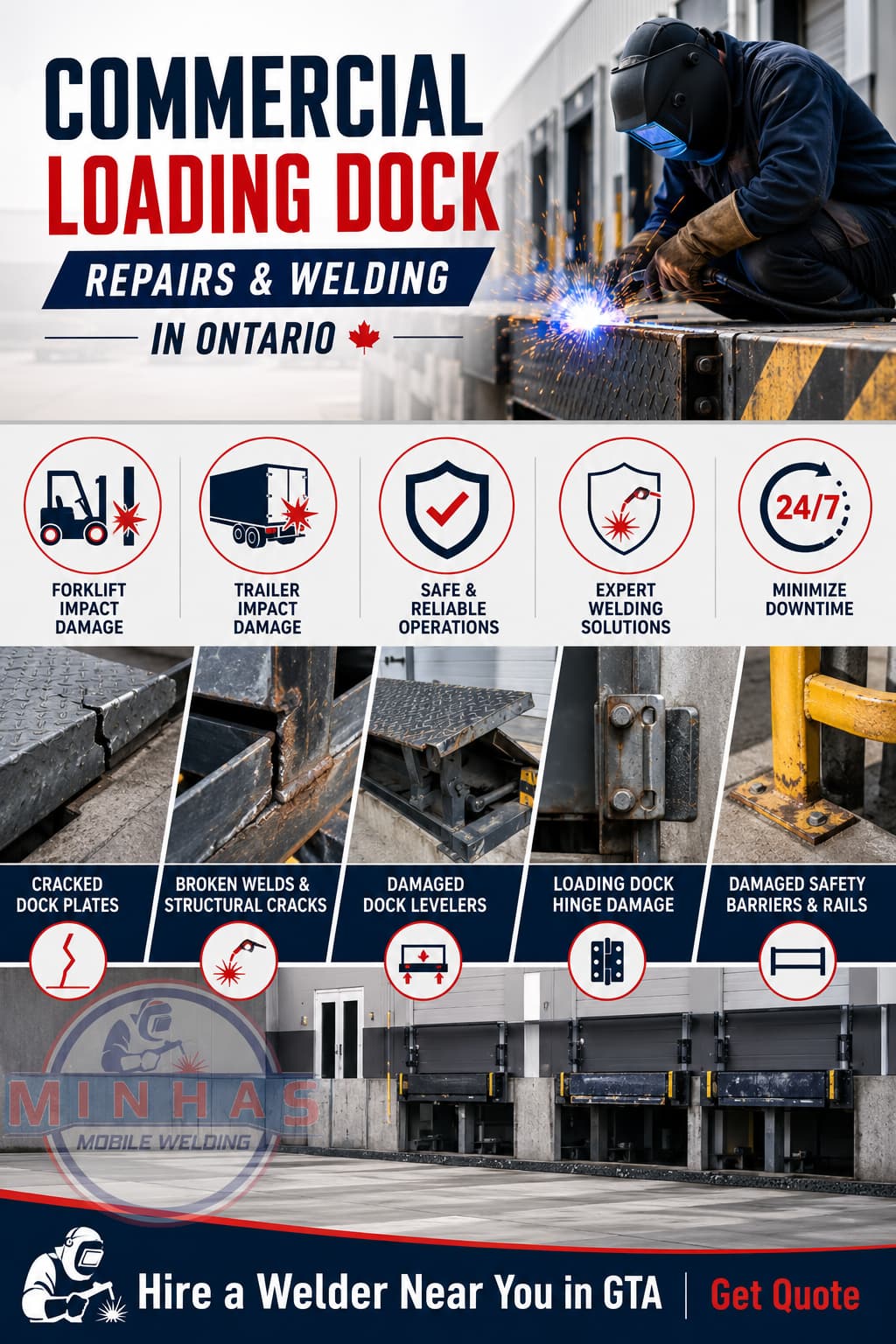
Commercial Loading Dock Repairs & Welding in Ontario

Commercial Loading Dock

Commercial loading docks are one of the busiest and most heavily used areas in warehouses, distribution centres, manufacturing facilities, and logistics operations across Ontario. Every day, these areas handle constant movement from forklifts, pallet jacks, delivery trucks, trailers, and heavy materials.

With thousands of loading cycles each year, even well-built dock structures experience wear and damage. Small issues such as cracked welds, loose steel components, bent dock plates, or damaged safety barriers can gradually become larger structural problems if they are ignored.

A damaged loading dock is more than a maintenance concern. It can slow down shipping operations, create workplace safety risks, damage equipment, and increase repair costs. Many businesses only contact a welder after a dock component completely fails, but early repairs can often prevent expensive downtime.

Commercial Loading Dock Repairs & Welding in Ontario: Common Problems, Warning Signs, and Repair Solutions

Professional loading dock welding repair in Ontario helps businesses restore damaged steel components, reinforce weak areas, and keep loading operations safe and reliable. Mobile welding services are especially valuable because repairs can often be completed directly at the facility without removing equipment or transporting large structures elsewhere.

This guide explains the most common commercial loading dock problems, warning signs that repairs may be needed, and how professional welding solutions can extend the lifespan of your loading infrastructure.

Why Commercial Loading Docks Develop Structural Problems

Commercial loading docks are designed to withstand demanding daily use, but several factors contribute to gradual damage. Understanding these causes helps facility managers identify problems before they become major repairs.

Heavy Forklift Traffic

Forklifts are essential for warehouse operations, but repeated impacts and heavy loads place significant stress on dock structures.

Common forklift-related damage includes:

  • Bent dock plates
  • Cracked support brackets
  • Damaged steel edges
  • Broken weld joints
  • Impact damage around dock bumpers and barriers

Even a minor forklift collision can weaken welded connections. Over time, repeated stress can cause cracks to expand and affect the structural integrity of the dock.

Trailer Impact Damage

Delivery trailers frequently connect and disconnect from loading bays throughout the day.

Incorrect positioning, driver error, or excessive impact during docking can damage:

  • Dock bumpers
  • Steel frames
  • Guide rails
  • Safety barriers
  • Dock leveler components

Trailer impacts are one of the most common reasons businesses require emergency loading dock welding repairs.

Weather Exposure and Corrosion

Ontario weather creates additional challenges for outdoor loading areas. Snow, freezing temperatures, moisture, and road salt can accelerate corrosion on exposed steel components.

Over time, rust can weaken:

  • Welded joints
  • Steel plates
  • Support frames
  • Hinges
  • Safety rails

Rust often starts on the surface but can eventually penetrate deeper into the metal, reducing strength and creating safety concerns.

Heavy Freight Loads

Loading docks support thousands of pounds of equipment and materials every day. Repeated loading and unloading cycles create stress on structural components.

Common problems caused by heavy loads include:

  • Metal fatigue
  • Cracked welds
  • Warped steel plates
  • Loose connections
  • Structural deformation

A dock may continue operating even when damage is developing underneath the surface. Regular inspections help identify these issues early.

Lack of Preventive Maintenance

Many businesses inspect equipment such as forklifts and machinery regularly but overlook loading dock structures.

Without routine checks, small issues can remain unnoticed until they create:

  • Equipment damage
  • Workplace hazards
  • Shipping delays
  • Emergency repair costs

A simple inspection schedule can identify worn components before they require major repairs.

Most Common Commercial Loading Dock Problems

Commercial loading docks include multiple steel components that work together. When one part fails, it can affect the entire loading process.

Cracked Dock Plates

Dock plates bridge the gap between the warehouse floor and the delivery trailer. They support forklifts, carts, and heavy loads during loading and unloading.

Over time, dock plates may develop:

  • Surface cracks
  • Bent edges
  • Broken weld connections
  • Weak support areas

A cracked dock plate creates an uneven transition area that can damage equipment and increase workplace safety risks. Professional welders can often repair damaged dock plates through reinforcement welding or fabrication repairs, depending on the severity of the damage.

Broken Welds and Structural Cracks

Welded connections are critical for maintaining the strength of loading dock structures. Continuous vibration and heavy impacts can cause welds to crack or separate.

Common locations for welding failures include:

  • Dock leveler frames
  • Steel supports
  • Guardrails
  • Hinges
  • Brackets
  • Reinforcement plates

Ignoring cracked welds can allow damage to spread into surrounding steel components.

Damaged Dock Levelers

Dock levelers help create a smooth transition between the warehouse floor and a trailer. When they stop working correctly, loading becomes slower and more dangerous.

Signs of dock leveler damage include:

  • Uneven movement
  • Difficulty raising or lowering
  • Excessive noise
  • Visible cracks
  • Misalignment

Depending on the condition, repairs may involve welding damaged frames, reinforcing steel components, or replacing worn sections.

Loading Dock Hinge Damage

Hinges experience repeated movement every time a dock component operates. Over time, hinges may become worn, bent, or detached.

Damaged hinges can cause:

  • Poor alignment
  • Uneven operation
  • Increased stress on nearby components

Welding repairs can restore damaged hinge connections and improve the overall reliability of the dock system.

Commercial Loading Dock Warning Signs That Require Repairs

Loading dock damage does not always appear as a major failure. In many cases, small warning signs indicate that structural repairs are needed before the problem affects daily operations.

Facility managers and business owners should regularly inspect loading areas and look for the following issues.

Visible Cracks in Steel Components

Cracks around welded joints, support brackets, dock plates, or frames should never be ignored.

Small cracks can expand due to:

  • Forklift traffic
  • Heavy freight movement
  • Temperature changes
  • Continuous vibration
  • Trailer impacts

A professional welder can assess whether the damaged area requires simple reinforcement, crack repair, or component replacement.

Unusual Movement or Noise

A loading dock should operate smoothly during normal use. Grinding sounds, excessive movement, or unusual vibrations often indicate damaged or worn components.

Common causes include:

  • Loose weld connections
  • Damaged hinges
  • Bent steel supports
  • Worn mechanical components

Addressing these issues early can prevent larger structural failures.

Rust Around Welded Areas

Rust around welds is a common warning sign in Ontario due to exposure to snow, moisture, and road salt.

Rust can weaken steel by reducing material thickness and affecting structural strength. Surface rust may only require cleaning and protective treatment, while deeper corrosion may require cutting out damaged sections and welding new steel.

Uneven Dock Plate Movement

Dock plates should provide a stable connection between the building and trailer. If a plate shifts, bends, or moves excessively during use, it may indicate:

  • Structural damage
  • Weak support points
  • Broken welds
  • Metal fatigue

An unstable dock plate creates unnecessary risks for forklift operators and warehouse employees.

Damaged Safety Barriers and Bollards

Safety barriers and bollards protect buildings, equipment, and workers from vehicle and forklift impacts.

Common problems include:

  • Bent protective posts
  • Cracked welds
  • Loose mounting points
  • Damaged steel rails

Repairing these components quickly helps maintain workplace safety and prevents further property damage.

Signs Your Loading Dock Needs Immediate Attention

Facility managers should arrange professional inspection or repairs if they notice:

  • Cracks spreading around weld joints
  • Dock plates bending under normal loads
  • Forklifts experiencing difficulty crossing the dock area
  • Visible rust affecting structural steel
  • Damaged safety rails or bollards
  • Dock leveler movement problems
  • Repeated equipment damage near the loading area
  • Loose or separated steel components
  • Unusual sounds during loading operations

Ignoring these warning signs can turn a minor repair into a costly shutdown.

Commercial Loading Dock Welding and Repair Solutions

Every loading dock repair depends on the type and severity of damage. A professional welder will inspect the structure, identify the cause of failure, and recommend the safest repair approach.

Structural Crack Welding

Cracked steel components can often be repaired through professional welding techniques.

The process may include:

  • Inspecting the damaged area
  • Removing damaged material if required
  • Preparing the steel surface
  • Welding and reinforcing the affected section
  • Testing the repaired area

Proper preparation is essential because welding over damaged or weakened metal may not provide a long-lasting repair.

Dock Plate Reinforcement

Damaged dock plates may require reinforcement welding to restore strength and improve durability.

Depending on the condition, repairs may include:

  • Adding reinforcement plates
  • Repairing cracked edges
  • Strengthening support points
  • Replacing severely damaged sections

This type of repair can extend the usable life of existing dock equipment.

Dock Leveler Frame Repairs

Dock leveler systems experience significant stress from repeated forklift movement. Damaged frames, brackets, and mounting points may require welding repairs.

Professional repairs can help restore:

  • Proper alignment
  • Smooth operation
  • Structural stability

Hinge Repairs and Reinforcement

Damaged hinges can affect the movement and safety of loading dock equipment. Welding repairs can restore damaged connections and reinforce weak areas.

Common hinge repair situations include:

  • Broken hinge welds
  • Bent mounting plates
  • Worn connection points
  • Cracked support sections

Steel Fabrication for Damaged Components

Some loading dock components may be too damaged for simple repairs. In these cases, custom steel fabrication may provide a better solution.

Fabricated replacement components may include:

  • Steel brackets
  • Support plates
  • Safety rails
  • Protective barriers
  • Custom reinforcement pieces

Mobile welding services allow these repairs to be completed directly at commercial facilities, reducing equipment transportation and downtime.

Loading Dock Repair vs Replacement: Which Option Makes Sense?

Not every damaged loading dock requires complete replacement. In many cases, professional repairs can restore strength and extend service life.

When Repairs Are Usually Enough

Repairs may be suitable when:

  • Damage is localized
  • Steel remains structurally sound
  • Cracks are limited to specific areas
  • Components can be reinforced safely
  • The overall dock system remains functional

Examples include repairing cracked welds, replacing damaged brackets, reinforcing dock plates, and repairing safety barriers.

When Replacement May Be Necessary

Replacement may become the better option when:

  • Severe corrosion has weakened the structure
  • Multiple components continue failing
  • Steel deformation affects safe operation
  • Repair costs approach replacement costs
  • The dock no longer meets operational requirements

A professional inspection helps businesses make informed decisions based on safety, repair costs, and expected lifespan.

Benefits of Addressing Loading Dock Problems Early

Reduce Operational Downtime

A failed loading dock can interrupt shipping schedules and delay deliveries. Preventive repairs help avoid unexpected shutdowns.

Improve Workplace Safety

Damaged dock components increase risks for forklift operators, warehouse employees, and delivery drivers. Proper repairs help maintain safer working conditions.

Extend Equipment Lifespan

Small repairs can prevent damage from spreading and extend the service life of expensive loading infrastructure.

Lower Long-Term Costs

Emergency repairs are often more expensive than scheduled maintenance. Identifying problems early helps businesses control maintenance expenses.

Protect Other Equipment

A damaged dock can affect forklifts, trailers, pallets, and other warehouse equipment. Maintaining the dock protects the entire loading operation.

Why Professional Loading Dock Inspections Matter

Commercial loading docks should be inspected regularly, especially in facilities with high daily traffic.

Industries that benefit from frequent inspections include:

  • Warehouses
  • Manufacturing plants
  • Distribution centres
  • Food processing facilities
  • Transportation companies
  • Retail supply chains

During an inspection, professionals typically evaluate:

  • Steel condition
  • Weld integrity
  • Dock plate strength
  • Safety barriers
  • Corrosion damage
  • Structural alignment

Businesses with heavy loading activity may require more frequent inspections than facilities with occasional deliveries.

Final Thoughts: Protect Your Loading Dock Before Small Problems Become Major Repairs

Commercial loading docks support some of the most important daily operations for Ontario businesses. When these structures experience cracks, corrosion, impact damage, or failed welds, delaying repairs can create unnecessary safety risks and operational challenges.

Regular inspections and professional loading dock welding repair in Ontario help businesses maintain reliable loading operations, prevent costly downtime, and extend the lifespan of their equipment.

Whether your facility needs dock plate reinforcement, structural welding, safety barrier repairs, or emergency mobile welding services, addressing problems early is the best way to protect your investment.

Frequently Asked Questions

Loading dock damage commonly results from forklift impacts, trailer collisions, heavy freight loads, corrosion, repeated use, and lack of maintenance. Over time, these factors can weaken steel components and welded connections.

Yes, many cracked loading dock plates can be repaired through professional welding and reinforcement. The repair approach depends on the location, severity, and overall condition of the steel.

Inspection frequency depends on usage levels and operating conditions. High-volume warehouses and distribution centres may benefit from more frequent inspections, while lower-use facilities may require scheduled annual checks.

Repairs are often effective when damage is limited to specific components such as weld joints, brackets, dock plates, or safety barriers. Replacement may be necessary when corrosion, deformation, or repeated failures affect the overall structure.

The cost depends on factors such as the damaged component, repair complexity, required materials, accessibility, and whether emergency service is needed. A professional inspection is the best way to determine accurate repair requirements. Get a free cost estimate.

Many mobile welding repairs can be completed on-site with proper planning. Businesses can often schedule repairs during slower periods to reduce disruption to warehouse operations.

Industries that rely heavily on loading docks include logistics companies, warehouses, manufacturing facilities, trucking operations, distribution centres, and large commercial properties.

Yes, mobile welders can often complete loading dock repairs directly at the facility. On-site welding reduces transportation requirements and helps businesses restore operations faster.

Industrial Welding & Pipe Fabrication for Data Centers

role of industrial welding in data centers in Ontario

Data centers are the keystone of today’s digital networks due to the rapid advances of AI, 5G, and cloud computing. As a result of these advances, data centers have proliferated in places like Ontario, and the demand for data centre’s in Toronto has led to the construction of new facilities almost before the last ones are completed.

Data Centers as Backbones: The Role of Industrial Welding & Pipe Fabrication

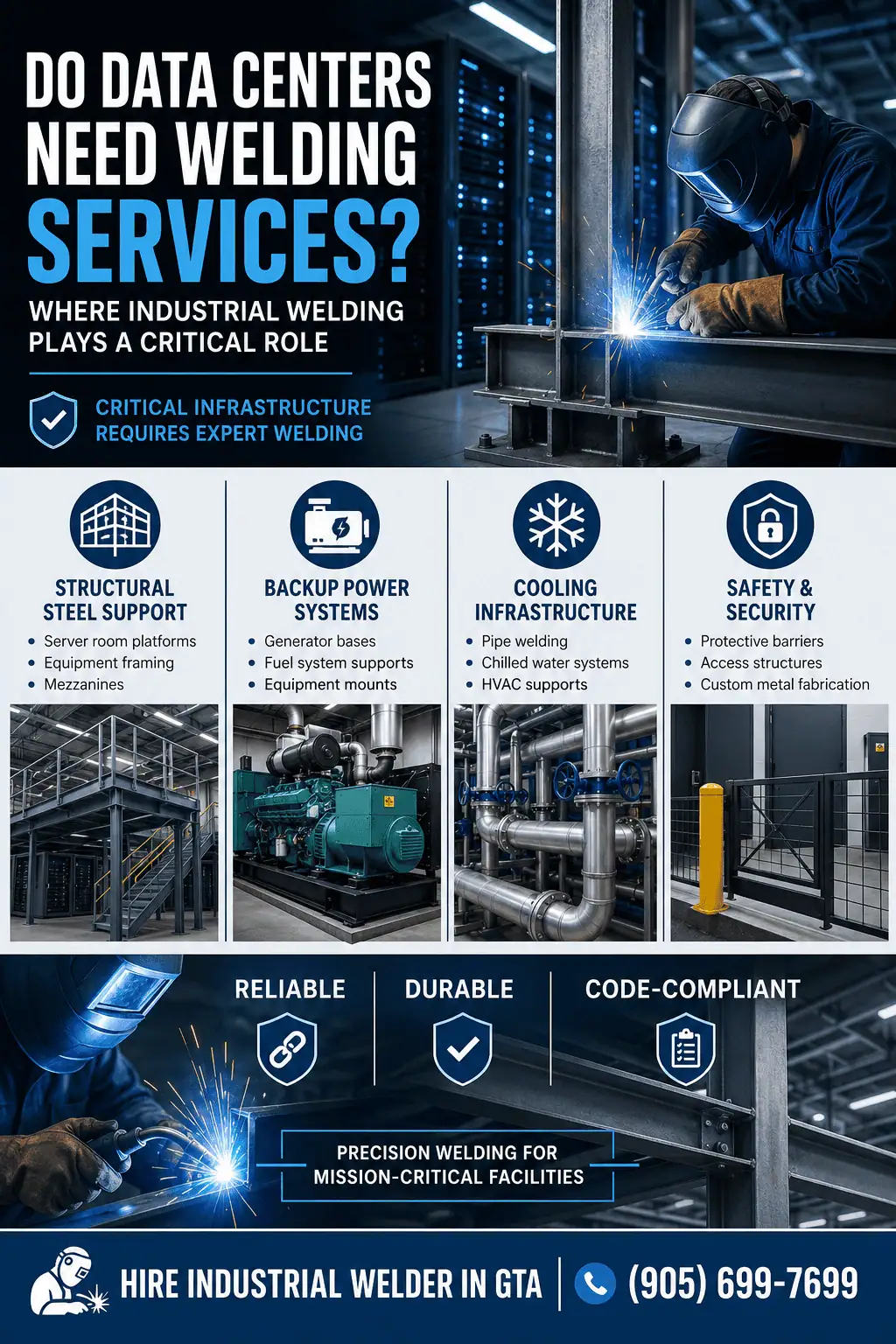
Behind seemingly endless virtual resources and processing power, data centers consist of massive (and massively expensive) physical infrastructure. High-density server rack systems, as well as advanced cooling systems, require these buildings to uphold uncompromising structural integrity. Consequently, mobile, precision welding services for data center infrastructure have become critical for a diverse range of needs, from the fabrication of cooling solution piping to the erection of structural steel.

1. High-Density Data Centers’ Needs and Steel Welding

Today’s data centers place incredible demands on facilities because of the intense heat generated by high-density AI or GPU clusters. Cooling systems for these advanced clusters push the limits of what a typical server rack can accommodate, necessitating the use of single frameworks that can hold multiple racks weighing in excess of 3,000 lbs.

To handle these extreme loads, infrastructure builders in Ontario must meet exacting structural standards such as the Canadian Welding Bureau (CWB). In this environment, structural steel industrial welding services for data center’s typically involve:

  • Load-Bearing Mezzanines & Catwalks: Elevated work areas built to hold large quantities of PDUs (Power Distribution Units) and backup units while still allowing maintenance teams safe access to perform service.
  • Seismic-Resistant Framing: In locations dealing with lateral forces and the continuous vibration of heavy equipment, brittle welds are inadequate. Thus, certified industrial welders frequently employ Complete Joint Penetration (CJP) welds in lieu of standard fillet welds. The extreme flexibility of CJP welds helps absorb these forces and prevents structural cracking.
  • Heavy Equipment Platforms: Structural framing built on rooftops or exterior walls to support massive backup generators and industrial HVAC equipment, ensuring they remain secure and operational for decades.

2. Pipe Welding & Prefabrication for Mission-Critical Liquid Cooling

Welded and piped cooling systems are becoming commonplace in data centers as processors increase in speed and traditional air-cooling systems become less effective. Because these piping networks run liquid directly alongside high-voltage electronics, they cannot leak. Therefore, the welding and piping of these cooling loops must be of the absolute highest quality.

To meet tight construction schedules, much of the welding used in data center construction is prefabricated off-site. Mobile teams can bring finished work modules to job sites much faster by constructing complicated pipe spools, valve assemblies, and mechanical skids in a controlled shop environment.

This modular system minimizes field errors, greatly reduces on-site coordination challenges, and simplifies the final integration process. Furthermore, it ensures that every chilled water line undergoes rigorous pressure testing before it is integrated into the live facility.

infographic showing importance of industrial welding in data centers in Ontario

3. Custom Metal Fabrication: Tailoring the Internal Infrastructure

Apart from the main structural and mechanical components, the interiors of data centers require a great deal of bespoke metal fabrication. This is to ensure the best possible use of the available space, optimized heat dissipation, and the provision of physical security. In most instances, bespoke metal fabrication is required to use the spaces where standard, off-the-shelf metal fabrication products cannot:

Infrastructure Domain Technical Challenge Engineered Fabrication Solution
Modular MEP Skids Integrating dense mechanical, electrical, and plumbing runs into ultra-compact pathways. Heavy-duty, structural steel frame enclosures engineered for drop-in field installation and structural rigidity.
High-Volume Cable Runways Managing thousands of fiber and copper lines while preventing localized heat stagnation. Custom overhead cable tray networks, containment systems, and custom drops designed to optimize airflow dynamics.
Critical Power Enclosures Protecting external generators, switchgear, and UPS systems from environmental hazards and noise pollution. Heavy-gauge, weather-sealed, and acoustically dampened custom sheet metal housings tailored to exact equipment dimensions.

Custom metal fabrication provides the necessary metal structural supports for modern, data-driven buildings.

4. The Lifecycle Support: Welding Services for Data Center Maintenance

The collaboration and partnership with an industrial welding specialist continues well beyond the construction phase. Arguably, the reliable welding services for Data Center maintenance is an essential requirement to ensure the safety of the facility’s continued operations, and to avoid expensive downtime.

Typical welding maintenance, both routine and unscheduled, primarily involves:

  • Cooling Loop Upgrades: Replacement and/or the addition of new, chilled water lines to facilitate the increased cooling demands when older cooling racks are removed and replaced with newer, liquid-cooled cooling racks.
  • Structural Retrofitting: Strengthening existing floor systems and structural bays to support unexpected additional weight during renovations of the facility.
  • Vibration and Fatigue Mitigation: Inspecting welded support brackets subjected to micro-vibrations of large HVAC fans, pumps, and generators, and repairing compromised joints.

Data centers are designed to provide 99.999% uptime. Therefore, most welding is carried out in a “live environment.” This requires certified mobile teams who have received advanced training to ensure that localized welding activities (such as heat, smoke, electrical perturbations, and other interferences) do not interfere with the delicate functions of the server room, which is in close proximity and active.

Partnering with the Right Welding Experts in Ontario

With the rapid proliferation of tech industries across the province, partnering with the right Ontario welding experts is becoming more essential than ever.

At Minhas Mobile Welding, we offer certified, precision structural steel welding, precise pipe welding, and custom metal fabrication tailored for critical industrial applications.

Our experienced mobile units bring certified expertise directly to your site, whether you are expanding a new hyperscale facility or need emergency repairs.

Check out Minhas Mobile Welding’s Specialized Industrial Solutions to ensure your data center infrastructure is durable, code-compliant, and fully prepared for any future maintenance needs to maximize your uptime.

Related Posts:

How Mobile Welding Companies in GTA Handle Complex 6G Pipe Repairs

Professional 6G Pipe Welding in GTA

A damaged pipe weld can bring an entire operation to a standstill, making 6G pipe repairs & welding an urgent priority for many businesses. Whether it happens at a manufacturing facility in Mississauga, a construction site in Toronto, or an agricultural operation outside Hamilton, unexpected pipe failures often lead to downtime, safety concerns, and costly delays.

For businesses that depend on piping systems to transport liquids, gases, or process materials, every hour of downtime matters. In many cases, moving damaged equipment to a welding shop is not practical. Large industrial systems, structural piping networks, and field-installed pipe assemblies often require repairs where they are located.

How GTA Welders Handle 6G Pipe Repairs?

This is where 6G Welding plays an important role. Known as one of the most challenging welding positions in the industry, 6G pipe welding requires a high level of skill, precision, and experience. Mobile welding companies that specialize in complex pipe repairs can perform critical welding work directly on-site, helping businesses restore operations while minimizing disruption.

Understanding how mobile welding companies approach complex 6G Pipe Welding Services can help property managers, contractors, facility operators, and equipment owners make informed decisions when pipe failures occur.

Understanding the Problem

What Is 6G Welding?

6G Welding refers to a pipe welding position where the pipe is fixed at approximately a 45-degree angle and cannot be rotated during welding. The welder must work around the pipe while maintaining consistent weld quality throughout the entire joint.

This position is widely recognized as one of the most demanding welding tests and real-world applications because it combines multiple welding positions into a single weld.

Why Do Pipe Weld Failures Occur?

Pipe weld failures can develop for several reasons, including:

  • Corrosion and rust
  • Vibration from equipment operation
  • Thermal expansion and contraction
  • Material fatigue
  • Improper installation
  • Environmental exposure
  • Heavy industrial usage
  • Impact damage from machinery

In commercial and industrial environments throughout the GTA, piping systems are often exposed to demanding conditions that increase wear over time.

Common Warning Signs

Property owners and facility managers should watch for:

  • Visible cracking around welds
  • Rust formation near welded joints
  • Fluid leaks
  • Pressure loss
  • Unusual vibrations
  • Discoloration around weld areas
  • Repeated maintenance issues

Identifying these signs early can help prevent larger failures and emergency shutdowns.

Why This Happens in Ontario?

Ontario presents unique challenges for piping systems and welded structures.

Freeze-Thaw Cycles

During winter, temperatures can fluctuate significantly. Water trapped in small cracks may freeze and expand, increasing stress on existing welds. Repeated freeze-thaw cycles can gradually weaken welded joints.

Road Salt and Corrosion

Commercial fleets, industrial equipment, and outdoor piping systems are frequently exposed to road salt and de-icing chemicals. These materials accelerate corrosion and can reduce the lifespan of welded components.

Heavy Industrial Use

Southern Ontario remains one of Canada’s busiest industrial regions. Manufacturing plants, warehouses, logistics facilities, and construction projects place constant demands on piping systems and welded assemblies.

Aging Infrastructure

Many commercial and industrial facilities across the GTA continue to operate with aging systems. Over time, welds experience stress from years of service, increasing the likelihood of repairs becoming necessary.

Seasonal Construction Demands

Construction projects in Toronto, Vaughan, Markham, and surrounding areas often operate under tight schedules. Pipe failures during critical project phases can quickly create costly delays if repairs are not completed promptly.

Risks of Ignoring the Problem

Ignoring damaged pipe welds can create serious consequences.

Safety Hazards

Cracked or failed welds can result in leaks, structural instability, or equipment malfunctions. In industrial environments, these issues may create risks for workers and site operations.

Increased Repair Costs

Small defects are generally less expensive to repair than complete system failures. Delaying repairs often allows damage to spread, increasing both labor and material costs.

Production Downtime

Manufacturing facilities and warehouses rely on uninterrupted operations. Pipe failures can halt production lines and affect delivery schedules.

Construction Delays

A failed weld on a construction site may prevent progress on multiple tasks. Delays can impact subcontractors, project timelines, and overall budgets.

Equipment Damage

Leaks and pressure loss can affect pumps, valves, compressors, and connected equipment, resulting in additional repair expenses.

Compliance Concerns

Commercial and industrial facilities may be required to maintain equipment that meets safety and operational standards. Unaddressed weld defects can create compliance issues during inspections.

Which Solutions is Ideal For You?

When pipe weld damage occurs, several options may be available depending on the severity of the issue.

Repair Existing Welds

In many situations, damaged sections can be repaired without replacing the entire system.

Advantages:

  • Lower cost
  • Faster turnaround
  • Reduced disruption

Limitations:

  • Not suitable for extensive damage
  • May require additional inspections

Full Replacement

Severely damaged piping may require replacement.

Advantages:

  • Long-term solution
  • Opportunity for upgrades

Limitations:

  • Higher cost
  • Longer downtime

In-Shop Welding

Some components can be removed and repaired in a welding facility.

Advantages:

  • Controlled environment
  • Specialized equipment access

Limitations:

  • Transportation costs
  • Equipment removal required

Mobile Welding Repairs

Mobile welding crews perform 6G pipe repairs directly at the site.

Advantages:

  • Minimal disruption
  • Faster response times
  • Reduced transportation needs

Limitations:

  • Weather conditions may affect scheduling
  • Site accessibility requirements

Fabrication and Reinforcement

In some situations, reinforcing existing pipe systems or fabricating replacement sections may provide the most practical solution.

When On-site Welding Makes Sense?

There are many situations where on-site welding offers clear advantage over welding shops near you.

Emergency Breakdowns

Unexpected failures rarely happen at convenient times. Mobile welders can respond directly to commercial, industrial, and agricultural sites to address urgent repairs.

Large Industrial Systems

Many industrial piping networks cannot be easily dismantled or transported. On-site welding eliminates the need for extensive disassembly.

Construction Projects

When schedules are tight, transporting components off-site may not be practical. Mobile welding helps maintain project momentum.

Heavy Equipment Repairs

Construction equipment, processing systems, and specialized machinery often require repairs where they are operating.

Farm Equipment During Peak Seasons

For Ontario farmers, equipment downtime during planting or harvest can have significant consequences. Mobile welding repairs can help restore critical equipment quickly.

Structural and Facility Repairs

Pipe supports, industrial frameworks, and connected steel components may require welding work alongside pipe repairs. Mobile welding teams can address multiple issues during a single visit.

What to Expect During the Process?

Understanding the repair process helps facility managers and property owners prepare effectively.

Initial Inspection

The welding team evaluates the damaged area and identifies the cause of the failure.

This may include:

  • Visual inspections
  • Weld condition assessment
  • Material evaluation
  • Safety reviews

Repair Planning

A repair strategy is developed based on:

  • Material type
  • Pipe thickness
  • Accessibility
  • Operating requirements
  • Environmental conditions

Site Preparation

Before welding begins, the area is prepared to ensure safe working conditions.

This may involve:

  • Cleaning the weld zone
  • Removing damaged material
  • Establishing safe access
  • Protecting nearby equipment

Welding Operations

During 6G Welding repairs, welders must carefully control:

  • Heat input
  • Joint alignment
  • Weld penetration
  • Weld consistency

Because the pipe remains fixed, welders continuously adjust their body position while maintaining quality throughout the weld.

Quality Checks

After welding is completed, inspections verify that repairs meet project requirements.

Checks may include:

  • Visual examination
  • Dimensional verification
  • Surface evaluation
  • Additional testing when required

Project Completion

The repaired system is reviewed and prepared for return to service, helping minimize operational disruptions.

Steps to Prevent Future Problems

While not all failures can be prevented, proper maintenance significantly reduces risk.

Schedule Regular Inspections

Routine inspections can identify small defects before they become major failures.

Address Corrosion Early

Remove rust and apply protective coatings where appropriate.

Monitor High-Stress Areas

Pay special attention to:

  • Pipe supports
  • Connection points
  • High-vibration equipment
  • Outdoor systems

Maintain Protective Finishes

Protective coatings help shield metal surfaces from moisture and environmental exposure.

Investigate Minor Leaks

Even small leaks may indicate larger underlying problems that require attention.

Prepare for Winter Conditions

Ontario winters can place additional stress on piping systems. Seasonal inspections before freezing temperatures arrive can help identify vulnerabilities.

Work With Qualified Welding Professionals

Complex pipe repairs require experienced welders who understand proper procedures, material requirements, and safety considerations.

Conclusion

Complex pipe weld failures can create significant challenges for businesses, contractors, property managers, and equipment owners across Ontario. Understanding the causes of weld damage, recognizing early warning signs, and addressing issues promptly can help reduce safety risks, minimize downtime, and control repair costs.

Because 6G Welding requires a high level of skill and precision, choosing experienced professionals is critical when repairs involve fixed-position pipe systems. Whether the issue occurs at a construction site, manufacturing facility, commercial property, or agricultural operation, timely repairs often make the difference between a manageable repair and a costly shutdown.

Whether you need emergency welding repairs, structural welding, 6G Pipe Welding Services, or on-site fabrication anywhere in the GTA, working with experienced mobile welders can help reduce downtime and keep your project moving.

Frequently Asked Questions

What makes 6G Welding more difficult than other welding positions?

6G Welding requires welding around a fixed pipe positioned at a 45-degree angle. Because the pipe cannot be rotated, the welder must continuously adjust position while maintaining consistent weld quality throughout the entire joint.

When are 6G Pipe Welding Services typically required?

These services are commonly used in industrial facilities, manufacturing plants, construction projects, processing systems, structural piping installations, and equipment repairs where high-quality pipe welds are required.

Can 6G pipe welding repairs be completed on-site?

Yes. Many mobile welding companies perform 6G pipe welding repairs directly at commercial, industrial, and agricultural sites, reducing downtime and eliminating transportation requirements.

How long do pipe welding repairs usually take?

Repair times vary depending on pipe size, material, accessibility, environmental conditions, and the extent of the damage. Simple repairs may be completed within hours, while complex projects may require additional time.

Are winter pipe welding repairs possible in Ontario?

Yes. Experienced mobile welders can perform many repairs during winter conditions. Additional preparation and weather protection measures may be necessary to maintain weld quality.

How can I tell if a pipe weld needs repair?

Common signs include visible cracks, rust around welds, pressure loss, leaks, unusual vibrations, and recurring maintenance issues. Early inspection can help prevent larger failures.

Is repair always better than replacement?

Not necessarily. Minor damage may be repaired effectively, while severe corrosion or structural deterioration may require replacement. An inspection helps determine the most practical solution.

What industries commonly use mobile welding services?

Industries that frequently rely on mobile welding include construction, manufacturing, transportation, warehousing, agriculture, commercial property management, and industrial operations.