You lose a commercial contract due to not having all your safety paper work. A different client is wanting environmental records, which you can’t provide. And meanwhile your large competitors continue to win industrial work all over Ontario because they already have the necessary ISO standards. In Canada, several businesses are facing this issue in 2026. While they recognize the importance of ISO, most owners does not fully understand what ISO 9001, 14001, 45001, and 27001 mean. They also overlook how crucial these standards are for their daily operations.
More and more Ontario industrial, fabrication, construction and field service companies are quickly finding that they clients first focus on the ISO 45001 standard.
What Do ISO 9001, 14001, 45001, and 27001 Actually Mean?
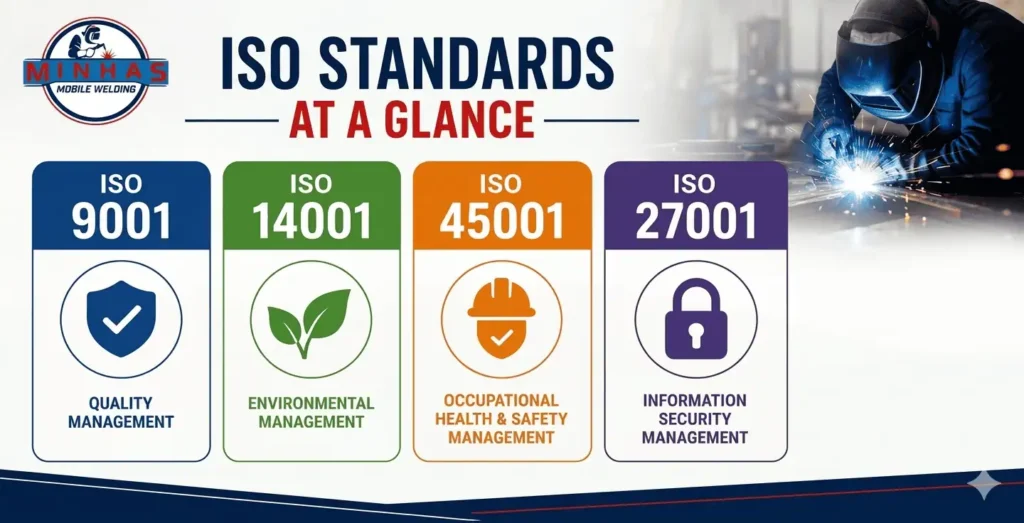
At a basic level, each ISO standard focuses on a different part of business operations.
ISO 9001 (Quality Management)
International Organization for Standardization created ISO 9001 to improve consistency, customer satisfaction, and operational quality.
This standard focuses on:
- Process control
- Quality assurance
- Customer satisfaction
- Documentation systems
- Continuous improvement
Ontario manufacturers and service providers often use ISO 9001 to win contracts where quality consistency matters. For example, if a fabrication company repeatedly delivers late weld repairs or inconsistent workmanship, ISO 9001 helps create repeatable systems that reduce errors.
ISO 14001 (Environmental Management)
ISO 14001 focuses on environmental responsibility.
This includes:
- Waste reduction
- Pollution prevention
- Fuel and energy management
- Environmental compliance
- Sustainable operations
Many businesses are facing this issue in 2026. They recognize the importance of ISO, but most owners don’t fully understand what ISO 9001, 14001, 45001, and 27001 mean. They also overlook how crucial these standards are for their daily operations.
Clients now ask questions about:
- Disposal methods
- Emissions
- Spill prevention
- Environmental reporting
Companies without clear systems often struggle during procurement reviews.
ISO 45001 (Occupational Health and Safety)
This is the standard that has become increasingly important across Ontario industrial sectors.
ISO 45001 focuses on:
- Worker safety
- Injury prevention
- Hazard identification
- Risk management
- Safe operating procedures
- Workplace accountability
If your business operates:
- Mobile welding units
- Fabrication equipment
- Heavy machinery
- Industrial repair services
- Commercial job sites
then ISO 45001 directly affects how clients evaluate your company.
In 2026, many commercial and industrial contracts prioritize safety compliance before pricing discussions even begin.
That shift matters.
ISO 27001 (Information Security)
ISO 27001 focuses on cybersecurity and data protection.
It applies heavily to:
- IT companies
- Healthcare providers
- Financial services
- SaaS companies
- Businesses handling sensitive customer data
This standard covers:
- Data breaches
- Access controls
- Security systems
- Information management
- Cybersecurity risk reduction
For industrial businesses, ISO 27001 is usually secondary unless client data security plays a major role.
The Real Difference Ontario Businesses Need to Understand
Most ISO comparison articles make the mistake of treating all standards equally.
That is not how Ontario businesses operate in reality.
A fabrication shop in Mississauga does not prioritize the same risks as a software company in Toronto.
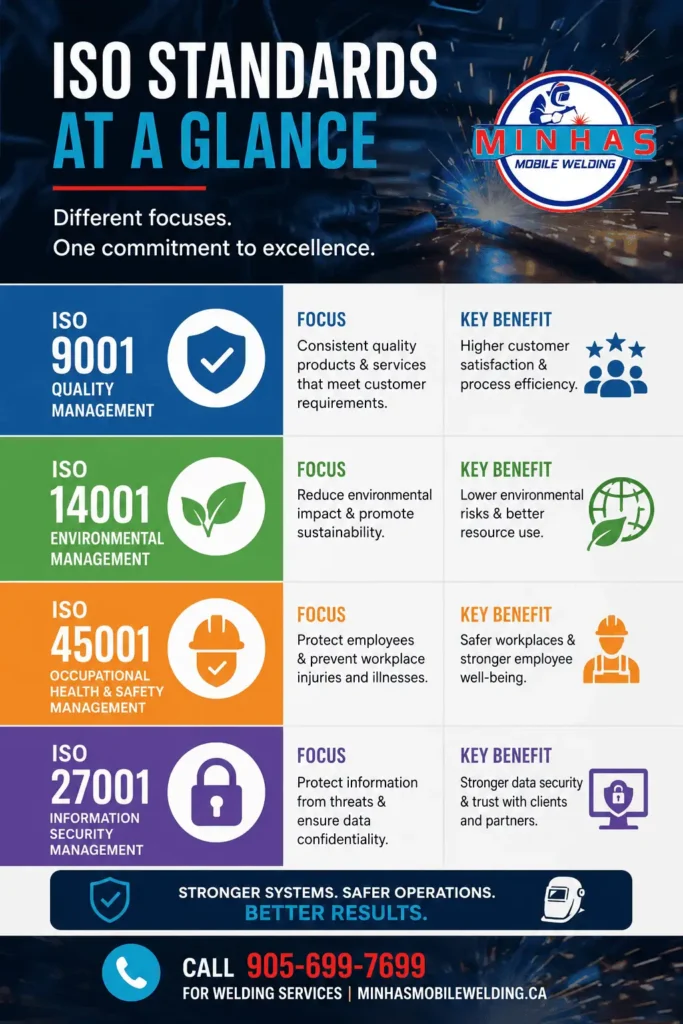
Here is the practical breakdown for 2026:
| ISO Standard | Main Focus | Biggest Benefit |
|---|---|---|
| ISO 9001 | Quality | Better consistency |
| ISO 14001 | Environment | Regulatory trust |
| ISO 45001 | Safety | Contract eligibility + lower risk |
| ISO 27001 | Cybersecurity | Data protection |
For industrial businesses, ISO 45001 often creates the fastest operational impact because safety failures immediately affect:
- Insurance costs
- WSIB claims
- Contract approvals
- Downtime
- Reputation
- Employee retention
That makes it far more urgent than many owners realize.
Why ISO 45001 Is Becoming the Most Important Standard in Ontario
Ontario businesses are under pressure from three directions at once:
- Higher insurance premiums
- Stricter contractor compliance requirements
- Skilled labour shortages
A single workplace injury now creates far bigger financial consequences than it did even five years ago. Many industrial clients also tightened vendor requirements after repeated safety incidents across construction and field service sectors.
Today, companies hiring welders, fabrication crews, or mobile repair services increasingly want proof that safety systems already exist.
That is one reason businesses working with companies like Minhas Mobile Welding often look for operational professionalism beyond basic repair work alone.
Mobile welding and industrial repair environments carry real risks:
- Confined spaces
- Hot work hazards
- Equipment failures
- Transportation risks
- Site coordination challenges
Without structured safety systems, small operational mistakes become expensive quickly.
What Happens Without ISO 45001?
Many Ontario business owners assume safety programs only matter for large corporations.
That assumption creates problems.
Here is what usually happens without a proper safety framework:
More Downtime
Unclear procedures slow projects down.
- Crews hesitate.
- Managers improvise.
- Documentation gets missed.
Then delays start stacking up.
Higher Insurance Costs
Insurers increasingly review:
- Incident history
- Safety documentation
- Training systems
- Risk mitigation processes
Poor records often lead to premium increases.
Lost Commercial Contracts
Larger contractors and municipalities now expect stronger compliance standards from subcontractors.
Without documented systems, smaller businesses often lose bids before pricing is even reviewed.
Employee Turnover
Skilled workers notice unsafe environments quickly.
In Ontario’s labour market, experienced tradespeople have options. Companies with poor safety culture struggle to retain talent.
ISO 9001 vs ISO 45001: Which Matters More?
For industrial and field service businesses in 2026, ISO 45001 usually delivers stronger operational value first.
Here is why.
- A quality issue might lead to a customer complaint.
- A safety issue can shut down a project entirely.
- That difference changes priorities.
Many Ontario businesses now approach certification in this order:
- ISO 45001
- ISO 9001
- ISO 14001
- ISO 27001
Especially in industries involving:
- Welding
- Construction
- Manufacturing
- Heavy equipment
- Mechanical repair
- Industrial maintenance
Companies handling on-site repairs, emergency fabrication, and structural work often benefit more from stronger safety systems before expanding into broader quality management frameworks.
That is especially true for mobile operations like those offered by Minhas Mobile Welding Services where crews operate across different job sites and conditions daily.
The Hard Part Most Businesses Avoid
ISO systems require discipline.
That is the part many consultants skip over.
You need:
- Documentation
- Employee buy-in
- Training consistency
- Internal accountability
- Operational structure
For small and mid-sized Ontario businesses, that feels overwhelming at first.
Owners already juggle:
- Staffing shortages
- Rising fuel costs
- Delayed payments
- Equipment expenses
- Tight project timelines
Adding another system can feel unrealistic.
But businesses that ignore operational structure usually end up spending more fixing preventable problems later.
What Changes When Safety Systems Actually Work
The biggest difference is operational clarity.
Before proper systems:
- Safety meetings feel rushed
- Procedures vary between crews
- Reporting stays inconsistent
- Problems repeat
After implementation:
- Expectations become clearer
- Job site communication improves
- Incidents decrease
- Clients gain confidence
- Teams work faster with less confusion
That operational stability matters more than the certification logo itself.
- Clients notice organized companies.
- Especially in industrial environments.
A mobile welding contractor arriving with documented procedures, clear communication, and structured operations creates a completely different impression than a company improvising site safety on arrival.
That professionalism is one reason many Ontario businesses increasingly choose experienced providers like Minhas Mobile Welding Blog Resources when searching for industrial repair and mobile welding insights.
Why 2026 Is a Turning Point for ISO 45001
Three major shifts are happening across Ontario right now.
Procurement Standards Are Tightening
Commercial property managers, municipalities, and industrial facilities now demand stronger contractor compliance documentation.
Basic insurance certificates alone are no longer enough.
Workplace Safety Scrutiny Is Increasing
Ontario businesses face greater visibility around workplace incidents.
Clients do not want vendor-related disruptions affecting operations.
Skilled Labour Is More Selective
Experienced tradespeople increasingly choose companies with:
- Safer environments
- Better systems
- Structured operations
- Clear communication
Safety culture has become a hiring advantage.
That was not true a decade ago.
Which ISO Standard Should Your Business Prioritize First?
Here is the practical answer.
Choose ISO 45001 First If You Operate:
- Welding services
- Construction crews
- Industrial repair teams
- Manufacturing operations
- Mechanical contracting businesses
- Mobile field services
Select ISO 9001 If You Focus On:
- Product consistency
- Manufacturing quality
- Customer process control
- Repeatable service delivery
Choose ISO 14001 If Environmental Compliance Drives Your Industry
Especially if you manage:
- Waste-heavy operations
- Fuel-intensive fleets
- Industrial disposal systems
Select ISO 27001 If You Handle Sensitive Digital Data
This matters most for:
- Technology firms
- Healthcare companies
- Financial organizations
For most Ontario industrial businesses, though, ISO 45001 creates the strongest immediate business impact.
Final Thoughts
Most Ontario businesses do not lose contracts because they lack technical skill. They lose opportunities because clients see operational risk.
That risk usually comes down to:
- Safety
- Documentation
- Consistency
- Accountability
ISO 45001 addresses all four.
In 2026, that matters more than ever for industrial contractors, mobile welding providers, fabrication shops, and commercial service companies trying to stay competitive in Ontario’s changing market.
If your business is reviewing operational improvements, safety processes, or industrial service support, small welding companies like Minhas Mobile Welding continue helping Ontario businesses handle mobile welding, on-site repairs, fabrication support, and industrial service demands with practical field experience and professional execution.
FAQs
Which ISO certification is best for construction and industrial companies in Ontario?
For most Ontario construction, welding, manufacturing, and industrial service businesses, ISO 45001 is often the most valuable certification in 2026. It focuses on workplace safety, hazard prevention, and operational risk reduction. Many commercial clients and services contractors now prioritize safety compliance before approving vendors or subcontractors.
What is the main difference between ISO 9001 and ISO 45001?
ISO 9001 focuses on quality management and improving consistency in products or services. ISO 45001 focuses on occupational health and safety, helping businesses reduce workplace injuries, improve job site procedures, and create safer working environments. For industrial businesses, ISO 45001 usually has a more direct impact on contracts, insurance, and daily operations.
Is ISO 45001 mandatory in Canada?
ISO 45001 is not legally mandatory in Canada, but many Ontario businesses now require it, or similar safety systems, during contractor evaluations and procurement processes. Companies with stronger safety documentation often gain a competitive advantage when bidding on industrial, commercial, and government projects.