A cracked equipment bracket. A trailer frame split down the rail. A gate hinge that finally gave out, or a guardrail bent flat by a forklift. Any one of these can shut down a yard for the day, especially when the broken piece is too big, too heavy, or too awkward to drag onto a flatbed and haul into a shop.
That’s the gap mobile welding fills for contractors and fleet managers across the GTA. Instead of loading a disabled trailer onto another trailer just to move it, a mobile welder shows up with the machine, the power source, and the know-how already in the truck.
Across Toronto and the surrounding region, mobile welding repairs cover everything from trailers and trucks to heavy equipment, industrial machinery, gates, structural steel, farm equipments, aluminum and stainless parts, piping supports, safety barriers, and the occasional 2 a.m. emergency. But not everything on that list should actually get welded on-site, and this guide walks through why.
What Is Mobile Welding?
Mobile welding means the welding trucks rigs and the technician travel to the broken part, wherever it happens to be sitting, instead of the part traveling to a shop. The welding process itself doesn’t change much.
Mobile welding is on-site metal repair, cutting, and fabrication carried out with portable equipment brought straight to a vehicle, structure, or piece of equipment. It skips the step of hauling that item into a fixed shop. The technician and the tools come to the job instead.
What changes is the setting. On-site work has to account for accessibility, ventilation, weather, fire risk, and whether the area around the repair can actually be secured while sparks are flying.
A mobile welder Toronto crews call out for a cracked dock plate is working under completely different conditions than a shop tech standing under a fume hood. Every single job, no matter how big or small, comes back to one practical question: can this specific repair be safely reached, prepped, welded, and checked over right where it sits?
30 Mobile Welding Repairs a Welder Can Potentially Handle On-Site
When equipment, structures, or metal components fail on-site, moving them to a welding shop is not always practical. Mobile welding repairs can often be completed where the problem occurs, saving time, reducing downtime, and avoiding transport costs.
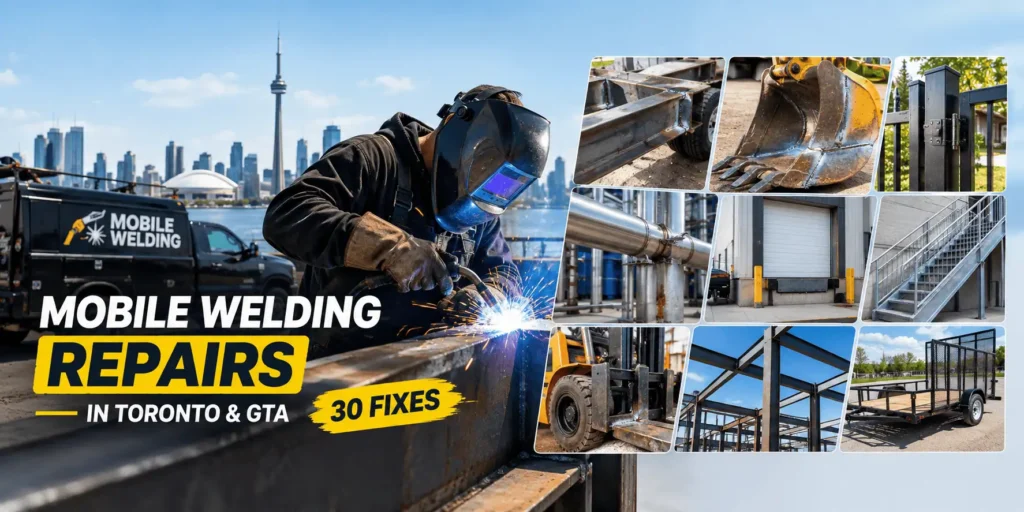
From gates and fences to trailers, machinery, docks, and structural components, here are 30 mobile welding repairs a welder can potentially handle on-site, depending on the damage, access, and repair requirements.
1. Mobile Welding for Broken Trailer Frames
Frame rails split from overload, fatigue, or plain old rust. A welder traces the crack back to its cause, checks how far it’s spread, then repairs or reinforces that section before the trailer goes back to work.
2. Trailer Ramp Welding & Repairs
Ramps absorb a beating every time something heavy rolls up or down them. Worn hinges, cracked brackets, and torn attachment points are usually fixable once the ramp is propped up and secured properly.
3. Dump Trailer Welding Repairs
Hoist mounts, hinge pins, and tailgate brackets crack from thousands of loading cycles. Before any welding starts, though, a loaded or unstable dump trailer needs to be locked down first.
4. Truck Body Welding Repairs
Box panels, brackets, and support rails on service trucks often just need a patch or some reinforcement, not a week off the road.
5. Heavy Equipment Frame Repairs
A crack in a heavy equipment frame changes how load travels through the whole machine. Load-bearing sections sometimes need engineering input before a torch even gets lit.
6. Excavator Bucket Welding Repairs
Cutting edges, tooth mounts, and bucket walls wear thin after enough digging. A mobile welder can rebuild those worn edges right on the site, no flatbed required.
7. Skid Steer Welding Repairs
Loader arms, mounting plates, and attachment brackets take a constant pounding. Cracks near pivot points show up often and are common repair candidates.
8. Forklift Welding Repairs
Guards and non-load-bearing brackets are usually field-repairable. Forks and mast components carry a different level of risk, though, and typically need a closer look first.
9. Conveyor Frame Welding Repairs
Support legs and mounting brackets crack under constant vibration. Fixing the conveyor frame in place beats tearing apart an entire production line.
10. Broken Gate Welding Repairs
Gate frames crack at their welded joints, and hinges pull loose from posts over time. Most gate and fence repairs happen with the gate propped up and held secure.
11. Commercial Door Welding Repairs
Steel door frames, hinge plates, and closer brackets wear down fast under heavy foot traffic. Repairing them on-site gets an entry back in service without much delay.
12. Loading Dock Welding Repairs
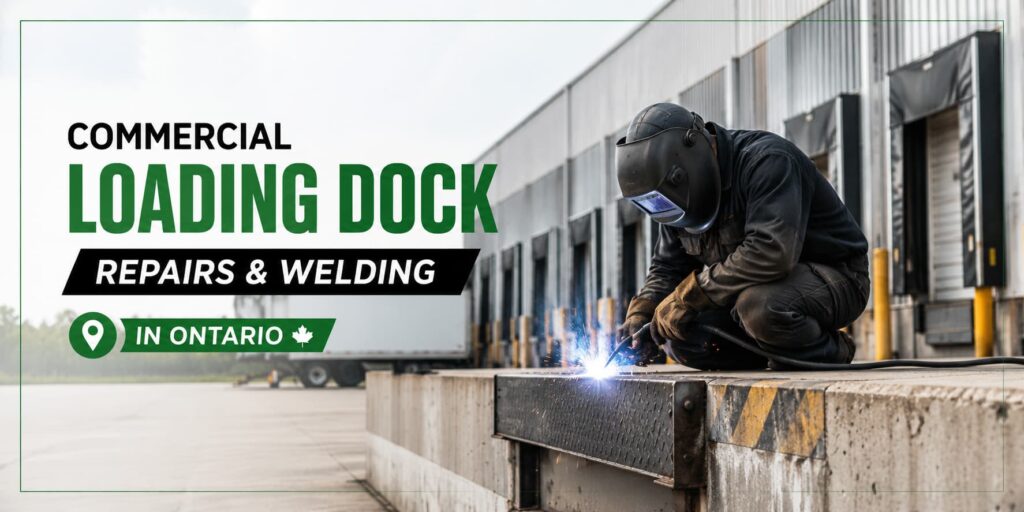
Dock plates, bumper brackets, and leveler frames absorb impact every single day. A damaged loading dock area should stay out of service until someone’s assessed it.
13. Stair & Handrail Welding Repairs
A loose handrail post or a cracked stair stringer isn’t a cosmetic problem, it’s a safety one. Any repaired system should be checked over before people start leaning on it again.
14. Structural Steel Crack Repairs
A crack in structural steel is rarely a simple welding job. It calls for figuring out the cause, proper prep work, and often an engineering review plus inspection afterward.
15. Steel Beam Reinforcement
Some beams need added plates or stiffeners to handle the loads they’re carrying now. Deciding how to reinforce them is an engineering call, guided by applicable codes.
16. Column Reinforcement Welding
Damaged columns sometimes need welded joist reinforcement too. Since columns carry a building’s weight, that decision hinges on confirmed load conditions and engineering review, not guesswork.
17. Equipment Bracket Welding
One broken mounting bracket can stop an entire machine or conveyor cold. These small fabricated parts are usually quick to rebuild right on-site.
18. Machinery Frame Welding
Cracked welds and fatigued frame sections show up often on production machinery. Repairing them in place skips the long process of disconnecting and reinstalling everything.
19. Agricultural Equipment Welding
Plows, seeders, and wagons break welds and crack brackets, usually at the worst possible time mid-season. Repairing them right on the farm beats hauling an awkward load anywhere.
20. Farm Trailer Welding
Farm trailers take a beating from rough terrain, showing up as frame damage, ramp problems, and failed hinges. On-site repair keeps them working without ever leaving the property.
21. Fence & Gate Hinge Welding
Hinge welds fail, and mounting plates tear loose from posts over time. These repairs are usually straightforward once the gate is properly supported.
22. Aluminum Trailer Welding
Aluminum demands alloy identification, careful surface prep, and heat control that steel doesn’t need. Rush a weld on an aluminum trailer and you’ll compromise the whole joint.
23. Aluminum Equipment Repairs
Aluminum frames, brackets, and housings can be repaired on-site as long as the alloy and joint design get identified correctly beforehand.
24. Stainless Steel Equipment Repairs
Stainless equipment in food-service and industrial settings needs careful cleanliness and tight heat control to keep its corrosion resistance intact.
25. Pipe Support Welding
Hangers and supports around piping are usually repairable on-site. Welding directly on pressurized or active piping is a different job entirely, with its own precautions.
26. Pipe Rack Repairs
Damaged pipe-rack frames and support brackets change how the piping above them gets loaded. Structural conditions need a review before any repair work starts.
27. Warehouse Rack Repairs
A bent rack upright isn’t automatically an easy weld fix. Rack systems often call for manufacturer guidance, inspection, or flat-out replacement instead.
28. Industrial Guardrail Repairs
Bent posts and broken brackets on guardrails undercut the protection they’re supposed to provide. Damaged sections need assessment before anyone puts them back into use.
29. Safety Barrier Welding
Bollards and barriers are designed to absorb impact. A repair should bring back that protective function, not just make the barrier look fine again.
30. Emergency Metal Repairs
Metal failures on fleet, construction, farm, or warehouse equipment tend to happen without warning and stop operations dead. Emergency mobile welding means someone can assess and repair on-site where that’s the right call.
When Is On-Site Welding Better Than Shop Welding?
There’s no fixed rule here, it depends on the specific repair in front of you. The table below covers situations mobile welders around Toronto and the GTA run into regularly, and where on-site work tends to make sense compared to when a shop is still the better call.
| Situation | Mobile Welding | Shop Welding |
|---|---|---|
| Large equipment cannot be transported | Strong option | Less practical |
| Emergency breakdown | Often useful | May cause transport delays |
| Small removable component | Sometimes unnecessary | Often practical |
| Large structural repair | May be suitable after assessment | May be preferred depending on scope |
| Remote equipment | Strong option | Transport required |
| Controlled fabrication | Less suitable | Strong option |
| Complex machining required | Limited | Better suited |
What Should You Tell a Mobile Welder Before They Arrive?
A clear description upfront lets a welder figure out whether a job is realistically suited to on-site work before a truck even leaves the yard.
Useful details include the type of equipment or structure, the location, the material if you know it, photos of the damage, rough dimensions, how it happened, whether the equipment still runs, whether the damaged part carries a load, any access limitations, your timing needs, and any safety restrictions on-site.
Photos paired with an accurate description usually tell a welder more than a phone call ever could.
When a Welding Repair Needs More Than Welding
Welding is frequently just one piece of a full repair. Depending on the job, the work might also call for engineering assessment, replacement parts, machining, extra fabrication, nondestructive testing, formal inspection, manufacturer specs, load testing, applicable codes and standards, or additional surface prep.
This shows up most with load-bearing frames, structural steel, columns, beams, safety barriers, and storage racks. A mobile welder who flags these needs before picking up a torch isn’t dodging the job. They’re telling you what an actual, lasting repair requires.
Why Choose Minhas as Mobile Welding in Toronto & the GTA?
For fleet operators, contractors, and industrial facilities across the region, the case for mobile welding is pretty simple. Equipment stays put instead of getting loaded and hauled somewhere, transport costs disappear, and downtime shrinks because the repair happens wherever the equipment already sits.
Construction sites, farms, warehouses, and industrial yards all get reached directly, no detour required. And when a breakdown hits without warning, getting a mobile welder out to assess things on-site usually beats arranging a tow or transport first.
The Bottom Line
A mobile welder can potentially fix a lot more than a broken gate or a split trailer frame. The range stretches from trailers and trucks to heavy equipment, machinery, industrial structures, farm equipment, aluminum and stainless parts, safety barriers, and the occasional emergency failure.
The real question isn’t whether something can technically be welded. It’s whether that specific repair can be safely and properly assessed, prepped, welded, and inspected right where it’s sitting.
Need Welder? We’ve Got You Covered!
When a metal component breaks, cracks, or needs reinforcement, you may not need to transport the equipment to a welding shop. A mobile welder can often bring the tools and equipment directly to your location, helping reduce hauling, delays, and unnecessary downtime.
From trailer and heavy equipment repairs to structural steel, gates, loading docks, and custom metal work, Minhas Mobile Welding provides on-site welding solutions across Toronto and the GTA. If you’re unsure whether your repair can be handled on-site, reach out to discuss your project and find the right welding solution. Call (905) 699-7699, or contact us today, 24×7 available.
Frequently Asked Questions
Can a mobile welder repair a broken trailer frame?
Yes, in many cases, once someone’s assessed the crack’s cause and how far it’s spread. Bigger structural sections or repeat failures might need shop-level fabrication or an engineering review instead.
Does every damaged metal component need to be removed before welding?
No, not usually. Plenty of brackets, gates and fences, and supports can be repaired right where they are, though load-bearing or safety-critical parts sometimes come off for a proper inspection or fabrication.
Can trailers be welded on-site?
Yes, as long as the alloy gets identified correctly and heat, cleanliness, and process selection are controlled properly. A rushed aluminum repair is far more likely to fail down the road.
When should I call a mobile welder instead of transporting equipment?
Call one when the equipment is too large, too heavy, stuck in place, or sitting somewhere transport would cause a real delay, and the damage looks field-repairable on inspection.
How long does an on-site mobile welding repair typically take?
It depends entirely on the damage, but many straightforward bracket, hinge, or frame repairs wrap up within a few hours once the welder’s on-site. More complex structural repairs involving engineering review or replacement parts can stretch across multiple visits.