Is Welding Aluminum Harder Than Steel? Is Welding Aluminum Harder Than Steel? (Yes, Here’s What That Means for Your Project in Ontario)

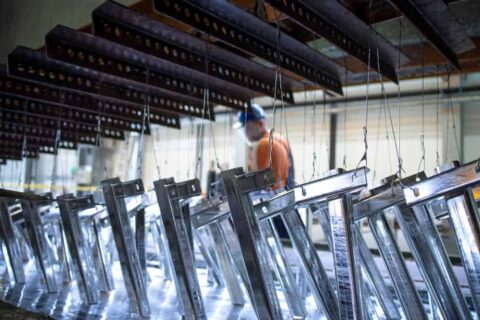
Aluminum welding process with fabricated metal frames suspended in workshop GTA

You’ve got a cracked aluminum boat trailer frame, a broken equipment ramp, or a custom job that requires welding aluminum and fabrication in your yard in Brampton, Mississauga, or somewhere in GTA. You call a few local welders. One quotes you twice what you expected. Another says they “can try it.” A third just doesn’t call back.

This does not mean you have bad luck. Aluminum welding is genuinely more demanding than steel, and most people don’t know why until they’ve already wasted time chasing the wrong contractor.

The Short Answer: Yes, Aluminum Is Harder to Weld

If you’ve ever watched a welder work on mild steel versus aluminum, the processes look similar from a distance. Same arc, same heat, same torch. But the gap in technical difficulty is significant.

Here’s the core difference:

Steel is forgiving. It tolerates variations in heat input, surface contamination, and technique. A welder with two years of experience can produce solid structural welds on mild steel. The metal behaves predictably. It tells you what it’s doing.

Aluminum doesn’t forgive it lies just below the surface waiting for it to give way. It conducts heat five times as efficiently as steel, therefore after you put heat in you the weld, heat flows away from the weld area nearly as quickly as you’re feeding it in, it also has an oxide layer.

Aluminum’s natural aluminum oxide coating on the surface of the metal has a far higher melting point than the aluminum underneath and unless properly removed prior to welding it will cause a contaminant that results in contamination, porosity, weak weld joints that appear to be good and can fail when stressed.

Because of the oxide layer, aluminum’s resistance to moisture, and also its ability to warp when subjected to unequal heating, experienced aluminum welders have a very different approach when doing jobs using aluminum. This will generally involve the use of different settings, filler rods, preparation, and often the use of a different process.

TIG vs MIG: Which Process Works for Aluminum?

For most aluminum welding in Ontario, you’re looking at two main processes: TIG (Tungsten Inert Gas) and MIG (Metal Inert Gas).

TIG Welding, Precision Work for Aluminum

TIG is the preferred way of welding Aluminum for thinner material or if weld and cosmetic finish are important. It is performed using non-consumable tungsten rod with the filler rod fed into the joint by hand, allowing extreme control over both the amount of heat being put in and also the bead profile.

Actually the use of AC (alternating current) mode when welding Aluminium actually aids in breaking down the oxide layer during the welding process itself which can be seen as overcoming the primary drawback of Aluminum welding.

The tradeoff? TIG is slower. It requires more skill than MIG and a higher level of training to execute consistently. A welder who does excellent TIG work on steel doesn’t automatically do excellent TIG work on aluminum, the variables are different.

For projects like aerospace-grade fabrication, automotive frames, marine components, or custom decorative aluminum structures, TIG is the standard. If you’re getting work done in the GTA, this is the process you want for high-precision aluminum.

MIG Welding, Speed for Thicker Aluminum

MIG welding aluminum is quicker and works better on larger sections (around 3mm and up), it’s a quick and easy method for large amounts of welding, structural aluminum, using a wire feed and shielding gas, but it depends on having the correct spool-gun, or push-pull liner to carry the soft aluminum MIG wire, as it birds-nests in the wire feeder.

So as you can imagine not every portable welder has one, so MIG is clean, quick and strong on aluminum, but only when you get it done by the correct welder, otherwise it’s burn-through, porosity and weld spatter.

For the Aluminum welding services at Minhas Mobile Welding, we do use both the TIG and MIG processes, with the right equipment, and skilled welders to make sure we use the best procedure on your aluminum welding job.

Why Most Ontario Contractors Get Aluminum Wrong

Here’s something nobody tells you upfront: the majority of welders working in the Greater Toronto Area are more comfortable with steel. That’s not a criticism, steel is the dominant material in construction, structural fabrication, and industrial work across Ontario. Most of the training pipelines, apprenticeship programs, and field experience are built around steel.

Aluminum welding is a specialty. It requires:

  • Good prep is not only needed: the metal has to be clean before the arc, using only steel brushes devoted to the aluminum only (used with steel as well, steel particles in the weld will be found in the weld),
  • Correct shielding gases, pure argon or argon/He blend, definitely not the Co-blend commonly used with MIG for steel,
  • Correct filler, matching filler alloy to base material (a wrong choice would hurt strength or corrosion resistance),
  • Heat input management, pre-heating on the cold Ontario winters, keep track of the distortion risk on long welds,

If you don’t do that, the weld looks OK but will fail under load sometimes weeks after, maybe months. A boat trailer that cracked a year after its “repair” is usually the symptom of one of these bad prep stages.

Steel vs Aluminum: A Practical Comparison for Ontario Projects

Factor Steel Aluminum
Skill level required Moderate High
Heat management Straightforward Critical, fast heat dissipation
Surface prep Important Mandatory, oxide layer removal
Common processes MIG, Stick, TIG TIG (preferred), MIG with spool gun
Cost to weld (GTA, 2026) Lower 20–40% higher on average
Weld speed Faster Slower (especially TIG)
Applications Structural, fencing, trailers Marine, automotive, custom fab

The cost difference is real. Aluminum welding typically runs 20–40% higher per hour than comparable steel work across the GTA, largely because of the additional prep time, specialized consumables, and the experience premium for qualified aluminum welders. Expecting to pay steel prices for aluminum work is how projects end up with the wrong contractor.

What Changes When You Work With the Right Welder

The practical reality is that most aluminum welding problems in Ontario come from one thing: hiring a generalist for a specialist job.

A welder who works regularly with aluminum, like the team at Minhas Mobile Welding, shows up with the right equipment already in the truck. We’ve done the prep correctly hundreds of times. We know which filler rod to use for your 6061 extrusion versus your 5052 sheet. Weve managed heat distortion on long trailer frames in January cold and August heat.

That experience means jobs that get done once, correctly. A trailer ramp repair that holds up under regular load. A marine aluminum bracket that doesn’t corrode at the weld line. A custom fabrication that fits your spec.

Minhas Mobile Welding has served the GTA for over a decade, handling everything from aluminum boat trailer repairs to structural commercial fabrication across Toronto, Mississauga, Brampton, Hamilton, and surrounding areas. Their 24/7 emergency response means you’re not waiting three days for a crew when something fails before a job.

Why 2026 Is a Different Aluminum Market in Ontario

Aluminum use across Ontario construction, manufacturing, and transportation sectors has climbed steadily. The push toward lighter-weight vehicle components (both commercial and personal), the expansion of prefab residential construction using aluminum framing elements, and the growth of recreational and marine industries around Lake Ontario and Georgian Bay have all increased demand for quality aluminum welding services.

At the same time, labor shortages in skilled trades, particularly among certified welders in Southern Ontario, have pushed timelines and pricing upward. Shops that could once absorb emergency jobs with a day’s notice are now booking out weeks. That’s not going to improve in the short term.

If you’re managing a commercial operation or even a one-time fabrication or repair job involving aluminum, getting the right contractor locked in matters more now than it did three years ago. Chasing the cheapest quote often means chasing rework.

Who Should Stick With a General Welder

Not every aluminum job needs a specialist. If you have a basic, non-structural repair on a thick aluminum section, a cracked frame piece with forgiving tolerances, for instance, an experienced welder with some aluminum background can handle it adequately.

Similarly, if your project is entirely mild steel (fencing, gates, structural steel, equipment stands), there’s no need to pay for aluminum-specialized rates. Steel work is steel work, and a skilled mobile welder with strong steel credentials is exactly what you need.

The specialist matters most when: the material is thin, the joint is structural, the application is high-stress (trailers, marine, load-bearing equipment), or the visual quality of the weld matters to the finished product.

Ready to Get a Quote?

If you’ve got an aluminum repair or fabrication project in the GTA, whether it’s a trailer, a custom structure, agricultural equipment, or something more complex, Minhas Mobile Welding offers free estimates with no obligation.

We come to your location, assess the job properly, and give you a realistic picture of what’s involved before any work starts. Get a free estimate from Minhas Mobile Welding, or call (905) 699-7699 to talk through your project directly.

Top Industrial Applications for Aluminum Welding

Industrial Applications for Aluminum Welding

Aluminum. Lightweight, durable, and corrosion-resistant. It’s the material that drives modernity, from the sleek bodies of electric vehicles to the massive liquefied natural gas (LNG) tanks on cargo ships. But none of these marvels would exist without a core skill: Aluminum Welding.

More challenging than welding steel, yet infinitely more rewarding, the ability to join aluminum alloys is a non-negotiable requirement for high-tech, high-performance industries globally. This comprehensive guide dives deep into the top industrial applications where expert aluminum welder services are required, explores the market driving this demand, and offers practical advice to anyone searching for the best aluminum welding near me.

Top Industrial Applications Where Aluminum Welding Needed

The global push for fuel efficiency, emission reduction, and performance enhancement has catapulted aluminum to the forefront of material science. Aluminum’s exceptional strength-to-weight ratio means that structural components can be significantly lighter than their steel counterparts without sacrificing durability.

Market Drivers for Aluminum Welding Services

The market for this specialized skill is not just stable; it’s experiencing rapid growth. Reports project the Aluminum Welding market to reach over $8 billion by 2031, growing at a CAGR of over 5% driven primarily by the automotive and aerospace sectors.
Industry SectorPrimary DriverAluminum Welding Need
Automotive & TransportationLightweighting for EV range & fuel economyBody frames, battery trays, engine blocks
Aerospace & DefenseMaximum strength at minimum weight (payload)Fuselage, wing structures, fuel tanks
Marine & ShipbuildingCorrosion resistance in saltwater environmentsHulls, superstructures, decks, dock repair
Construction & InfrastructureDurable, low-maintenance, and aesthetic materialsStructural framing, bridges, architectural facades

This commercial interest highlights why high-quality, professional welding aluminum services are an essential investment, not a mere expense.

🚀 Application Spotlight 1: Automotive and Electric Vehicles (EVs)

The automotive industry is arguably the single largest catalyst for the demand for skilled aluminum welding. The transition to Electric Vehicles (EVs) has intensified this trend, as reducing mass directly translates to increased battery range—the holy grail of EV engineering.

Lightweighting the Modern Vehicle

  • Body-in-White (BiW) Structures: Modern high-end and performance vehicles use all-aluminum or mixed-material body structures. Welding aluminum alloys like 6061 and 6063 forms the core structural cage, providing crucial rigidity and crash safety.
  • Engine & Transmission Components: Even in traditional internal combustion engine vehicles, aluminum remains key for engine blocks, cylinder heads, and transmission cases due to its superior heat dissipation properties and light weight.
  • EV Battery Enclosures and Trays: This is a critical, high-precision application. The battery tray that houses the EV’s power source must be structurally robust to protect against impacts, yet perfectly sealed to guard against moisture and fire. This requires highly precise, often robotic, MIG and TIG aluminum welding.

Expert Insight: “The tolerances for EV battery trays are often measured in microns. Any porosity or inclusion caused by hydrogen in the weld compromises safety and thermal management. This is why we rely on sophisticated AC TIG and Pulsed MIG for these vital assemblies.

✈️ Application Spotlight 2: Aerospace and Defense

In aerospace, the rule is simple: every pound saved is profit gained. Aluminum, particularly the 2XXX and 7XXX series alloys, has been the backbone of aircraft construction for decades.

High-Strength, High-Performance Structures

  • Fuselage and Wing Assemblies: The primary structure of most commercial aircraft relies heavily on welded aluminum components. Alloys like 2219 (used in the Space Shuttle External Tank) and 6061 are favored for their excellent weldability and high strength at elevated temperatures.
  • Fuel and Cryogenic Tanks: Tanks for aircraft, rockets, and ground support equipment often use aluminum due to its ability to maintain ductility and strength at cryogenic temperatures (essential for handling liquid oxygen and hydrogen).
  • Precision Defense Equipment: From missile casings to drone frames, lightweight structural integrity is key. The demand for portable, high-quality mobile aluminum welding for repair and maintenance on airfields and remote defense sites is constant.
Industry Insight

NASA reports that aluminum alloys make up nearly 80% of modern aircraft components, emphasizing the metal’s unmatched utility in aerospace engineering.

🚢 Application Spotlight 3: Marine and Offshore Fabrication

Saltwater is the nemesis of many metals, but marine-grade aluminum welding offers a powerful solution. Aluminum alloys in the 5XXX series, specifically 5083 and 5052, are renowned for their exceptional corrosion resistance in harsh marine environments.

Hulls, Superstructures, and Offshore Vessels

  • Boat and Ship Hulls: From luxury yachts to high-speed ferries, patrol boats, and fishing trawlers, aluminum hulls offer significant speed and efficiency advantages over steel due to the reduced drag from lower weight. The integrity of these welds is paramount for seaworthiness.
  • Superstructures: The deckhouses and upper parts of large commercial vessels and cruise ships are often made of aluminum to lower the center of gravity, increasing stability and reducing the hull’s overall stress.
  • Offshore Rigs and Platforms: While steel dominates, aluminum is used for helicopter decks, gangways, and equipment housing where ease of maintenance and resistance to the sea’s elements are critical.

This sector often searches for an expert mobile aluminum welder capable of performing dockside repairs, demanding specialized equipment and deep field experience.

🏗️ Application Spotlight 4: Construction, Infrastructure, and General Fabrication

Beyond the heavy hitters, welding aluminum is vital in everyday construction and specialty fabrication, offering aesthetic appeal, structural performance, and longevity.

  • Architectural & Structural Components: Aluminum curtain wall systems, facades, window frames, and structural trusses utilize welded aluminum for a clean finish and low maintenance.
  • Highway Signs and Bridge Decks: Its weather resistance and light weight make it ideal for large overhead signs and modular bridge decking, reducing the load on supporting infrastructure.
  • Pressure Vessels and Storage Tanks: The food, chemical, and pharmaceutical industries rely on welded aluminum tanks for storing sensitive materials, where its non-toxic, non-sparking properties, and purity are essential.
Alloy SeriesBest for WeldabilityTypical Industrial Use
3XXX (Al-Mn)Very GoodHeat exchangers, piping, fuel tanks
5XXX (Al-Mg)Excellent (Marine Grade)Hulls, cryogenic tanks, pressure vessels
6XXX (Al-Mg-Si)Good (Structural)Automotive frames, architectural structure

Application Spotlight 5: Electronics & High-Tech Equipment

Modern tech relies on aluminum for its thermal conductivity and light weight.

Uses

  • Heat sinks
  • Lightweight casings
  • Cooling systems
  • Precision housings for industrial electronics

Why Welding Is Required

Some electronic components need custom-fabricated aluminum housings that can withstand heat without bending or cracking.

Application Spotlight 6:Food Processing & Medical Equipment

Clean, sanitary environments benefit massively from aluminum’s properties.

Applications

  • Worktables and racks
  • Cleanroom supports
  • Sterilization equipment
  • Custom medical fabrication

Aluminum’s corrosion resistance and cleanliness make it ideal for industries that cannot risk contamination.

TIG vs. MIG: Which is Best for Aluminum?

When you hire an aluminum welder, they will typically choose between two methods based on the job requirements.

TIG Welding (GTAW)

  • Best For: Thin materials, aesthetic welds, automotive parts, aerospace components.
  • Pros: Highest quality welds, precise control, visually beautiful “stack of dimes” look.
  • Cons: Slow process, requires high operator skill.

MIG Welding (GMAW)

  • Best For: Thick plates, ship hulls, structural construction, trailer manufacturing.
  • Pros: Fast travel speeds, easier for long welds.
  • Cons: Higher risk of porosity, less visually appealing than TIG.

🔧 The Expert Edge: Navigating the Challenges of Aluminum Welding

These challenges are why specialized expertise is crucial when looking for an aluminum welder or a shop offering high-quality aluminum welding near me.

1. Oxide Layer: Aluminum forms a tough, ceramic-like oxide layer (Al2O3) that melts at approx 2072.C – far higher than pure aluminum’s approx 660.C melting point.

  • Solution: Use Alternating Current (AC) TIG welding. The AC cycle’s electrode positive (EP) half-cycle cleans the surface, blasting away the oxide layer to expose the molten metal beneath.

2. High Thermal Conductivity: Aluminum dissipates heat extremely quickly, making it difficult to maintain a stable weld pool and achieve deep penetration.

  • Solution: Employ higher amperage settings and fast travel speeds. For thicker sections, preheating the workpiece slightly can help maintain the necessary welding temperature.

3. Porosity: Molten aluminum readily absorbs hydrogen (from moisture, oil, or dirty material), which is then expelled during solidification, leading to small, trapped bubbles (porosity) that weaken the weld.

  • Solution: Meticulous preparation is non-negotiable. Use a dedicated, clean stainless steel brush and non-chlorinated solvent to clean the joint immediately before welding. Ensure shielding gas (100% Argon is standard) is pure and the base metal is completely dry.

4. Hot Cracking: Certain alloys (like some 6XXX and 7XXX series) are susceptible to cracking upon cooling due to shrinkage stress.

  • Solution: Use a carefully selected filler metal (often from the 4XXX or 5XXX series) that lowers the cracking susceptibility of the weld zone chemistry.

📞 Ready to Weld the Future?

Don’t let the technical challenges of aluminum hold your project back. From high-speed transport to essential industrial fabrication, our team provides certified, on-site, and in-shop aluminum welding services tailored to the highest industry standards. Discover the difference that precision, preparation, and specialized knowledge can make for your structural, marine, or automotive components.

Explore our specialized aluminium welding services today and get free a quote for any Aluminum project: Click here to view our Aluminium Welding Services

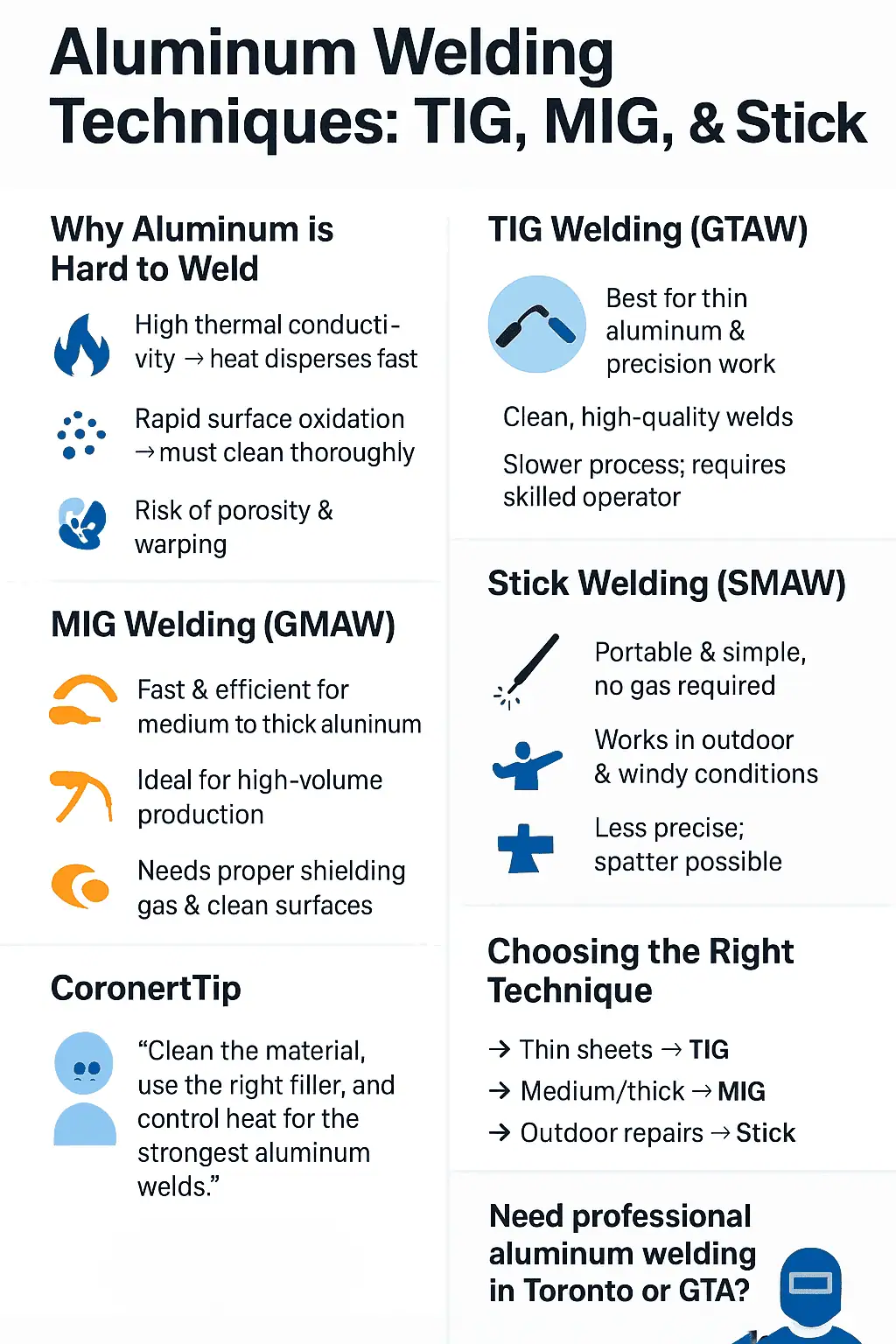
Aluminum Welding Techniques: TIG, MIG, and Stick Explained

aluminum welding techniques

Aluminum is one of the most widely used metals across industries, from automotive and construction to aerospace and manufacturing. Its lightweight, corrosion-resistant, and durable properties make it a top choice. However, aluminum welding is challenging, which is why mastering the right aluminum welding techniques, TIG, MIG, and Stick, is essential.

In this article, we’ll break down these welding methods, their advantages, challenges, and real-world applications to help you choose the right approach for your project.

Why Aluminum Welding is Challenging

Before diving into aluminum welding techniques, let’s address why aluminum isn’t as straightforward as steel welding:

  • High thermal conductivity: Aluminum dissipates heat quickly, making it harder to maintain the weld pool.
  • Oxidation issues: The surface oxidizes rapidly, requiring precise cleaning before welding.
  • Porosity risks: Moisture and contaminants can cause porous welds, reducing strength.
  • Soft material: Aluminum can easily warp, crack, or burn through under improper heat control.

These challenges make technique selection, TIG, MIG, or Stick, critical for success.

aluminum welding techniques infographic

Aluminum Welding Techniques Overview

Here’s a quick comparison of the three main techniques used for aluminum welding:

Aluminum Welding Technique Best For Key Benefits Main Challenges
TIG (GTAW) Thin aluminum, precision work Clean, high-quality welds Slower, requires skill
MIG (GMAW) Medium to thick aluminum, speed Fast, efficient, versatile Susceptible to porosity
Stick (SMAW) Outdoor & repair work Simple setup, portable Less precision, spatter


TIG Welding Aluminum (Gas Tungsten Arc Welding)

TIG welding is considered the gold standard for aluminum welding.

Advantages of TIG Welding Aluminum:

  • Produces high-quality, precise, and clean welds.
  • Excellent for thin aluminum sheets (common in HVAC ducts, bicycles, and automotive panels).
  • Allows for greater control over heat input using a foot pedal.

Challenges:

  • Requires significant skill and training.
  • Slower compared to MIG welding.
  • Equipment costs are generally higher.

💡 Pro Tip: Use an AC power supply with high-frequency start for aluminum TIG welding. This helps break up the oxide layer on aluminum’s surface.

Best Applications:

  • Aerospace components
  • Automotive bodywork
  • Food-grade equipment
  • Artistic metalwork and custom fabrication

MIG Welding Aluminum (Gas Metal Arc Welding)

MIG welding is one of the most popular and accessible aluminum welding methods, especially in industrial settings.

Advantages of MIG Welding Aluminum:

  • Faster and more efficient than TIG welding.
  • Works well on thicker aluminum materials.
  • Can be semi-automated, making it ideal for production lines.

Challenges:

  • Higher risk of porosity if shielding gas or cleaning isn’t perfect.
  • Not as precise as TIG welding.
  • Wire feeding issues may occur, aluminum wire is softer than steel.

💡 Pro Tip: Use a spool gun or push-pull gun to prevent wire tangling during MIG aluminum welding.

Best Applications:

  • Shipbuilding and marine fabrication
  • Construction (windows, doors, structural frames)
  • Automotive repair shops
  • Manufacturing industries requiring high-volume welding

Stick Welding Aluminum (Shielded Metal Arc Welding)

Stick welding, though less common for aluminum, still has a place, particularly in repairs and outdoor conditions.

Advantages of Stick Welding Aluminum:

  • Portable and simple setup (no shielding gas required).
  • Works well in windy or outdoor environments where MIG/TIG may fail.
  • Effective for thicker aluminum repairs.

Challenges:

  • Produces less aesthetic welds with more spatter.
  • Limited to specific aluminum electrodes.
  • Less control and precision compared to TIG and MIG.

Best Applications:

  • Outdoor welding jobs
  • On-site repairs (construction equipment, pipelines)
  • Heavy-duty applications where appearance is less important
  • Choosing the Right Aluminum Welding Technique

When deciding which welding method is right for you, consider these factors:

Thickness of Aluminum:

  • Thin sheets → TIG
  • Medium to thick sections → MIG
  • Very thick repairs → Stick

Environment:

  • Controlled indoor shop → TIG or MIG
  • Outdoor repairs → Stick

Skill Level:

  • Beginners → MIG or Stick
  • Advanced welders → TIG

End Use:

  • High-precision industries (aerospace, food-grade) → TIG
  • Speed and volume (construction, manufacturing) → MIG
  • Rugged field repairs → Stick

Expert Insight:

“Aluminum welding is all about preparation and control. Clean the material thoroughly, use the right filler rod, and choose the technique that balances speed and quality for your application.”

Final Thoughts

Aluminum welding isn’t a one-size-fits-all process. TIG, MIG, and Stick welding each offer unique benefits depending on your project’s needs, whether that’s precision, speed, or field repairs.

If you’re in Toronto or the GTA and need reliable aluminum welding, working with certified professionals ensures durable, clean, and safe results.

👉 Ready to get your project started? Contact Minhas Mobile Welding Services today for expert aluminum welding solutions right at your doorstep.