How Mobile Welding Companies in GTA Handle Complex 6G Pipe Repairs

Professional 6G Pipe Welding in GTA

A damaged pipe weld can bring an entire operation to a standstill, making 6G pipe repairs & welding an urgent priority for many businesses. Whether it happens at a manufacturing facility in Mississauga, a construction site in Toronto, or an agricultural operation outside Hamilton, unexpected pipe failures often lead to downtime, safety concerns, and costly delays.

For businesses that depend on piping systems to transport liquids, gases, or process materials, every hour of downtime matters. In many cases, moving damaged equipment to a welding shop is not practical. Large industrial systems, structural piping networks, and field-installed pipe assemblies often require repairs where they are located.

How GTA Welders Handle 6G Pipe Repairs?

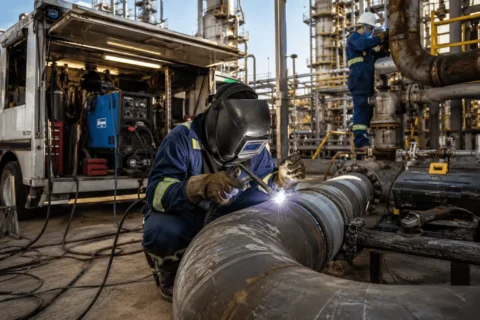
This is where 6G Welding plays an important role. Known as one of the most challenging welding positions in the industry, 6G pipe welding requires a high level of skill, precision, and experience. Mobile welding companies that specialize in complex pipe repairs can perform critical welding work directly on-site, helping businesses restore operations while minimizing disruption.

Understanding how mobile welding companies approach complex 6G Pipe Welding Services can help property managers, contractors, facility operators, and equipment owners make informed decisions when pipe failures occur.

Understanding the Problem

What Is 6G Welding?

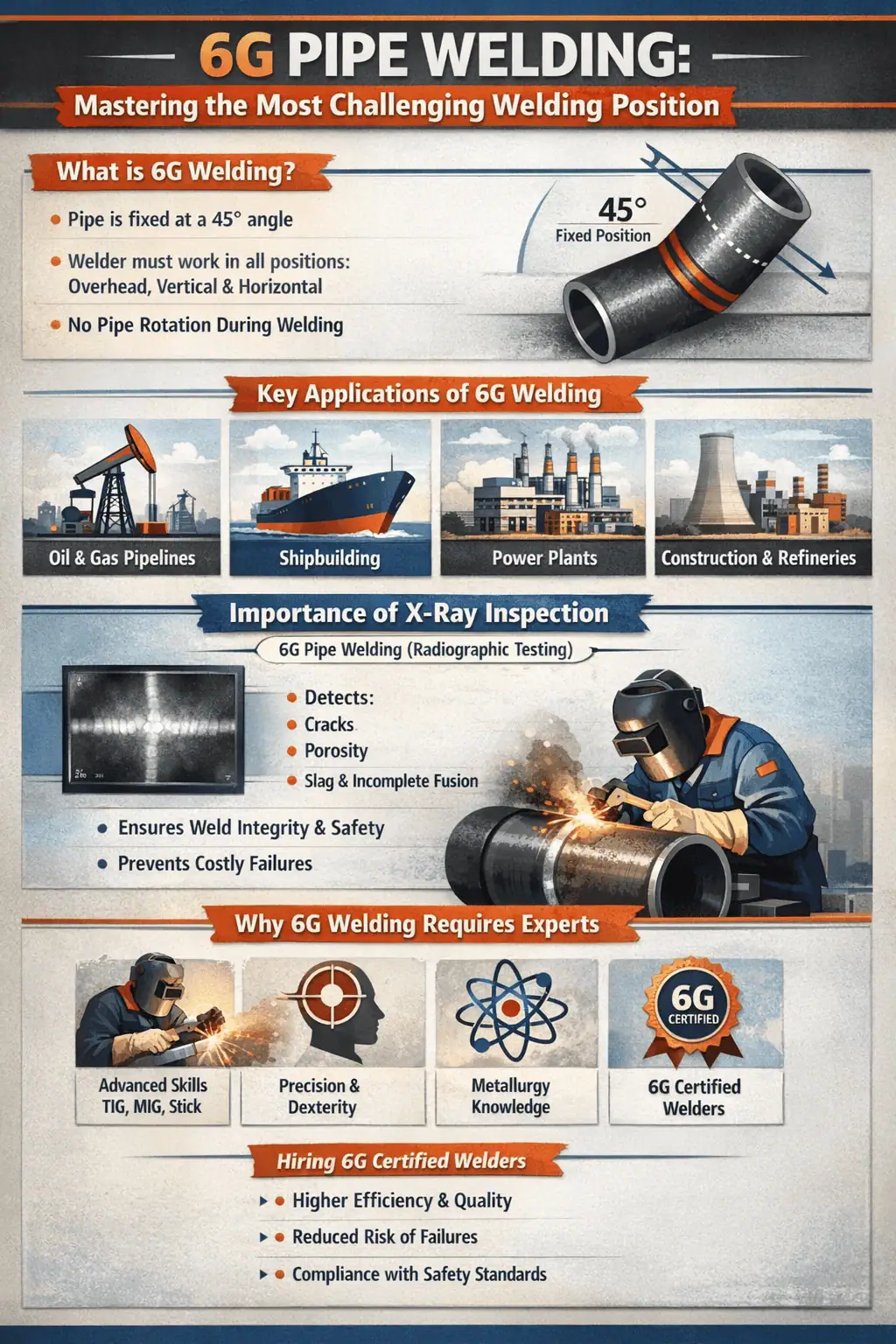
6G Welding refers to a pipe welding position where the pipe is fixed at approximately a 45-degree angle and cannot be rotated during welding. The welder must work around the pipe while maintaining consistent weld quality throughout the entire joint.

This position is widely recognized as one of the most demanding welding tests and real-world applications because it combines multiple welding positions into a single weld.

Why Do Pipe Weld Failures Occur?

Pipe weld failures can develop for several reasons, including:

  • Corrosion and rust
  • Vibration from equipment operation
  • Thermal expansion and contraction
  • Material fatigue
  • Improper installation
  • Environmental exposure
  • Heavy industrial usage
  • Impact damage from machinery

In commercial and industrial environments throughout the GTA, piping systems are often exposed to demanding conditions that increase wear over time.

Common Warning Signs

Property owners and facility managers should watch for:

  • Visible cracking around welds
  • Rust formation near welded joints
  • Fluid leaks
  • Pressure loss
  • Unusual vibrations
  • Discoloration around weld areas
  • Repeated maintenance issues

Identifying these signs early can help prevent larger failures and emergency shutdowns.

Why This Happens in Ontario?

Ontario presents unique challenges for piping systems and welded structures.

Freeze-Thaw Cycles

During winter, temperatures can fluctuate significantly. Water trapped in small cracks may freeze and expand, increasing stress on existing welds. Repeated freeze-thaw cycles can gradually weaken welded joints.

Road Salt and Corrosion

Commercial fleets, industrial equipment, and outdoor piping systems are frequently exposed to road salt and de-icing chemicals. These materials accelerate corrosion and can reduce the lifespan of welded components.

Heavy Industrial Use

Southern Ontario remains one of Canada’s busiest industrial regions. Manufacturing plants, warehouses, logistics facilities, and construction projects place constant demands on piping systems and welded assemblies.

Aging Infrastructure

Many commercial and industrial facilities across the GTA continue to operate with aging systems. Over time, welds experience stress from years of service, increasing the likelihood of repairs becoming necessary.

Seasonal Construction Demands

Construction projects in Toronto, Vaughan, Markham, and surrounding areas often operate under tight schedules. Pipe failures during critical project phases can quickly create costly delays if repairs are not completed promptly.

Risks of Ignoring the Problem

Ignoring damaged pipe welds can create serious consequences.

Safety Hazards

Cracked or failed welds can result in leaks, structural instability, or equipment malfunctions. In industrial environments, these issues may create risks for workers and site operations.

Increased Repair Costs

Small defects are generally less expensive to repair than complete system failures. Delaying repairs often allows damage to spread, increasing both labor and material costs.

Production Downtime

Manufacturing facilities and warehouses rely on uninterrupted operations. Pipe failures can halt production lines and affect delivery schedules.

Construction Delays

A failed weld on a construction site may prevent progress on multiple tasks. Delays can impact subcontractors, project timelines, and overall budgets.

Equipment Damage

Leaks and pressure loss can affect pumps, valves, compressors, and connected equipment, resulting in additional repair expenses.

Compliance Concerns

Commercial and industrial facilities may be required to maintain equipment that meets safety and operational standards. Unaddressed weld defects can create compliance issues during inspections.

Which Solutions is Ideal For You?

When pipe weld damage occurs, several options may be available depending on the severity of the issue.

Repair Existing Welds

In many situations, damaged sections can be repaired without replacing the entire system.

Advantages:

  • Lower cost
  • Faster turnaround
  • Reduced disruption

Limitations:

  • Not suitable for extensive damage
  • May require additional inspections

Full Replacement

Severely damaged piping may require replacement.

Advantages:

  • Long-term solution
  • Opportunity for upgrades

Limitations:

  • Higher cost
  • Longer downtime

In-Shop Welding

Some components can be removed and repaired in a welding facility.

Advantages:

  • Controlled environment
  • Specialized equipment access

Limitations:

  • Transportation costs
  • Equipment removal required

Mobile Welding Repairs

Mobile welding crews perform 6G pipe repairs directly at the site.

Advantages:

  • Minimal disruption
  • Faster response times
  • Reduced transportation needs

Limitations:

  • Weather conditions may affect scheduling
  • Site accessibility requirements

Fabrication and Reinforcement

In some situations, reinforcing existing pipe systems or fabricating replacement sections may provide the most practical solution.

When On-site Welding Makes Sense?

There are many situations where on-site welding offers clear advantage over welding shops near you.

Emergency Breakdowns

Unexpected failures rarely happen at convenient times. Mobile welders can respond directly to commercial, industrial, and agricultural sites to address urgent repairs.

Large Industrial Systems

Many industrial piping networks cannot be easily dismantled or transported. On-site welding eliminates the need for extensive disassembly.

Construction Projects

When schedules are tight, transporting components off-site may not be practical. Mobile welding helps maintain project momentum.

Heavy Equipment Repairs

Construction equipment, processing systems, and specialized machinery often require repairs where they are operating.

Farm Equipment During Peak Seasons

For Ontario farmers, equipment downtime during planting or harvest can have significant consequences. Mobile welding repairs can help restore critical equipment quickly.

Structural and Facility Repairs

Pipe supports, industrial frameworks, and connected steel components may require welding work alongside pipe repairs. Mobile welding teams can address multiple issues during a single visit.

What to Expect During the Process?

Understanding the repair process helps facility managers and property owners prepare effectively.

Initial Inspection

The welding team evaluates the damaged area and identifies the cause of the failure.

This may include:

  • Visual inspections
  • Weld condition assessment
  • Material evaluation
  • Safety reviews

Repair Planning

A repair strategy is developed based on:

  • Material type
  • Pipe thickness
  • Accessibility
  • Operating requirements
  • Environmental conditions

Site Preparation

Before welding begins, the area is prepared to ensure safe working conditions.

This may involve:

  • Cleaning the weld zone
  • Removing damaged material
  • Establishing safe access
  • Protecting nearby equipment

Welding Operations

During 6G Welding repairs, welders must carefully control:

  • Heat input
  • Joint alignment
  • Weld penetration
  • Weld consistency

Because the pipe remains fixed, welders continuously adjust their body position while maintaining quality throughout the weld.

Quality Checks

After welding is completed, inspections verify that repairs meet project requirements.

Checks may include:

  • Visual examination
  • Dimensional verification
  • Surface evaluation
  • Additional testing when required

Project Completion

The repaired system is reviewed and prepared for return to service, helping minimize operational disruptions.

Steps to Prevent Future Problems

While not all failures can be prevented, proper maintenance significantly reduces risk.

Schedule Regular Inspections

Routine inspections can identify small defects before they become major failures.

Address Corrosion Early

Remove rust and apply protective coatings where appropriate.

Monitor High-Stress Areas

Pay special attention to:

  • Pipe supports
  • Connection points
  • High-vibration equipment
  • Outdoor systems

Maintain Protective Finishes

Protective coatings help shield metal surfaces from moisture and environmental exposure.

Investigate Minor Leaks

Even small leaks may indicate larger underlying problems that require attention.

Prepare for Winter Conditions

Ontario winters can place additional stress on piping systems. Seasonal inspections before freezing temperatures arrive can help identify vulnerabilities.

Work With Qualified Welding Professionals

Complex pipe repairs require experienced welders who understand proper procedures, material requirements, and safety considerations.

Conclusion

Complex pipe weld failures can create significant challenges for businesses, contractors, property managers, and equipment owners across Ontario. Understanding the causes of weld damage, recognizing early warning signs, and addressing issues promptly can help reduce safety risks, minimize downtime, and control repair costs.

Because 6G Welding requires a high level of skill and precision, choosing experienced professionals is critical when repairs involve fixed-position pipe systems. Whether the issue occurs at a construction site, manufacturing facility, commercial property, or agricultural operation, timely repairs often make the difference between a manageable repair and a costly shutdown.

Whether you need emergency welding repairs, structural welding, 6G Pipe Welding Services, or on-site fabrication anywhere in the GTA, working with experienced mobile welders can help reduce downtime and keep your project moving.

Frequently Asked Questions

What makes 6G Welding more difficult than other welding positions?

6G Welding requires welding around a fixed pipe positioned at a 45-degree angle. Because the pipe cannot be rotated, the welder must continuously adjust position while maintaining consistent weld quality throughout the entire joint.

When are 6G Pipe Welding Services typically required?

These services are commonly used in industrial facilities, manufacturing plants, construction projects, processing systems, structural piping installations, and equipment repairs where high-quality pipe welds are required.

Can 6G pipe welding repairs be completed on-site?

Yes. Many mobile welding companies perform 6G pipe welding repairs directly at commercial, industrial, and agricultural sites, reducing downtime and eliminating transportation requirements.

How long do pipe welding repairs usually take?

Repair times vary depending on pipe size, material, accessibility, environmental conditions, and the extent of the damage. Simple repairs may be completed within hours, while complex projects may require additional time.

Are winter pipe welding repairs possible in Ontario?

Yes. Experienced mobile welders can perform many repairs during winter conditions. Additional preparation and weather protection measures may be necessary to maintain weld quality.

How can I tell if a pipe weld needs repair?

Common signs include visible cracks, rust around welds, pressure loss, leaks, unusual vibrations, and recurring maintenance issues. Early inspection can help prevent larger failures.

Is repair always better than replacement?

Not necessarily. Minor damage may be repaired effectively, while severe corrosion or structural deterioration may require replacement. An inspection helps determine the most practical solution.

What industries commonly use mobile welding services?

Industries that frequently rely on mobile welding include construction, manufacturing, transportation, warehousing, agriculture, commercial property management, and industrial operations.

What Is 6G Welding? Positions, Challenges, and Uses

6G welding positions

Ask any pipe welder which test makes their hands go a little shaky. Nine times out of ten, they say 6G pipe welding. Here’s why. The pipe gets clamped at an angle and it never moves again. Not an inch. To get the 6G welding position explained simply: the welder has to walk all the way around that fixed pipe, welding the entire time, while the position keeps flipping from easy to brutal every few inches of travel. 

That’s the whole trick behind 6G welding. One weld. Four different positions crammed into a single, unbroken pass. Welding companies keep a keen eye out for 6G-qualified welders because that certification, often the final hurdle in 6G welding qualification, proves something real. 

It shows a person can control heat, speed, and arc length even while everything around the joint keeps changing. Those same skills carry straight into pressure piping jobs, food plants, and big structural fabrication work. 

What Is 6G Welding, Really?

Meaning: 6G welding is a pipe test position where the pipe sits fixed at roughly a 45-degree tilt and stays locked there the whole time. Since the pipe can’t spin or roll, the welder has to move around it instead, which means the 6G welding test position itself keeps changing between flat, vertical, and overhead conditions inside one single joint. 

The number 6 just tells you which position number the welding codes use to classify pipe welding positions. The G stands for groove weld. Other positions let you roll the pipe so you’re always sitting pretty in a comfortable spot. Not the 6G pipe welding position. That pipe gets locked into a stand at 45 degrees and it stays put no matter what. 

Imagine a six-inch schedule 40 pipe clamped into a 6G stand. Down at the bottom, you’re basically doing a flat weld. Up the sides, it starts feeling like vertical welding. Near the top, it turns into something close to overhead work, dripping metal and all. Same joint. Three totally different jobs. 

Since the pipe won’t budge, the welder has to keep shifting body position, torch angle, and travel speed dozens of times just to keep up with gravity pulling on that molten puddle. That’s exactly why 6G gets treated as the benchmark test instead of something you’d see on a normal production line. 

Why Does Everyone Say 6G Welding Position's So Hard?

Gravity treats the weld pool differently at every single point around that fixed pipe. Down at the bottom, the puddle behaves and stays where you put it. Near the top, it wants to sag, drip, and generally misbehave, kind of like trying to spread frosting on a cake that’s tipped sideways.

Then there’s access. A 6G test stand often sits at a height that leaves part of the joint out of easy reach. So the welder crouches. Or kneels. Or leans at some weird angle, trying to hold the right torch angle without losing sight of the puddle. 

Travel speed and heat have to shift constantly too. Slow down a touch at the bottom so the root fuses properly. Speed back up near the top so the bead doesn’t sag under its own weight. Small adjustments. Over and over. 

Visibility changes on you as well. At the six o’clock starting point, you can usually see straight into the joint. By the time you’re up near twelve o’clock, you’re often welding half blind, relying on feel and peripheral vision more than an actual clear view. 

Bottom line: 6G welding earns its reputation because it stuffs four positions’ worth of technique (flat, horizontal, vertical, and overhead) into one nonstop weld. No pausing. No repositioning the pipe. You just adapt your 6G welding techniques on the fly. 

How the 6G Position Moves Around the Clock

Think of the pipe joint like a clock face lying on its side. Six o’clock sits at the bottom. Twelve o’clock sits at the top. Three and nine mark the sides. Most welders start near the bottom and work up both sides toward the top, following whatever sequence the 6G welding procedure or welding procedure specification (WPS) lays out. 

Near six o’clock, things behave close to a flat or downhill weld. The puddle sits still. Root fusion is usually the easiest part of the whole joint right here. 

Head toward three or nine o’clock and the joint starts acting like a vertical weld. Now you’re fighting gravity on the pool while keeping penetration steady, often using a small weave or whip motion depending on the process running. 

By the time you reach twelve o’clock, it’s basically overhead welding. Metal wants to fall. So the welder shortens the arc length (the gap between the electrode tip and the puddle), tightens up travel speed, and dials back heat to keep the bead from sagging or blowing through. 

A root pass that looks perfect at six o’clock can turn into a lack-of-fusion mess by twelve o’clock if the welder doesn’t adjust technique section by section. That shift is exactly what separates a seasoned 6G welder from someone who’s only ever welded easier positions.

6G vs. Other Pipe Welding Positions

Welding codes sort pipe positions by number: 1G, 2G, 5G, and 6G, based on how the pipe sits and whether it spins during the weld. Line them up side by side and you’ll see why 6G sits at the top of the difficulty chart.

Position

Pipe 

Orientation

Welder Movement 

Difficulty

Common 

Applications

1G

Horizontal, pipe rotates

Welder stays put; pipe spins

Lowest

Shop fabrication with rotating fixtures

2G 

Vertical, fixed

Welder moves around a still, upright pipe

Moderate

Structural pipe, some process piping

5G 

Horizontal, fixed

Welder moves around a still, horizontal pipe

High

Pipeline tie-ins, fixed process pipe

6G

Fixed at roughly 45 degrees

Welder moves all the way around an inclined, fixed pipe

Highest

Qualification testing, critical pipe fabrication

1G gives welders the easy road since the pipe spins and you stay in a comfy flat spot the whole time. 6G rips that comfort away completely. That’s exactly why so many welding programs treat a passed 6G test as proof someone can handle nearly any pipe position underneath it.

What Skills a 6G Welder Actually Needs

Arc control sits at the top of the list. You need to hold a steady arc length even as your whole body shifts position every few inches around that pipe. 

Travel speed matters just as much. Move too fast at six o’clock and you get a lack of fusion. Move too slow at twelve o’clock and you get burn-through or a sagging bead. A good 6G welder feels that speed changes instead of thinking it through step by step. 

Torch or electrode angle has to shift constantly too, both the travel angle (tilt in the direction you’re moving) and the work angle (tilt relative to the joint), to keep the puddle where it belongs and dodge undercut on either side of the groove. 

Reading the WPS matters more than people expect. That written procedure spells out amperage, travel speed, filler metal, and preheat for the joint. Stick to those 6G welding requirements and you stay inside qualified limits instead of guessing your way through.

6G Welding Prep Checklist 

  • Confirm pipe material, diameter, and wall thickness match the WPS
  • Check bevel angle, root gap, and land dimensions on the joint prep
  • Clean off mill scale, oil, and moisture before striking an arc
  • Double check amperage, polarity, and filler metal against the procedure
  • Set up good lighting and a stance you can actually hold around the pipe
  • Tack the pipe securely so it can’t shift mid-weld
  • Run through the root, fill, and cap sequence in your head before starting 

Process choice depends on the job in front of you. SMAW (stick) still handles a lot of root passes in the field since it forgives less-than-perfect fit-up. GTAW (TIG) often welds the root on thinner or higher-purity pipe because it gives tighter control over the puddle. 

GMAW and FCAW show up more in shops with better access and higher deposition needs. The right pick always comes back to material, joint design, and what the WPS demands, not personal preference.

6G Welding Test vs. 6G Welder Qualification

A 6G welding test usually runs on a section of pipe, often six-inch schedule 40, beveled and clamped into a stand at that fixed 45-degree angle. The welder runs a root pass, one or more fill passes, and a cap pass, following the amperage and technique laid out in the qualifying WPS. 

After welding, the joint goes through visual inspection first, checking for surface issues like undercut, cracking, or incomplete fusion. Depending on the code and client, it might also go through nondestructive examination, things like radiography (X-ray) or ultrasonic testing, which check weld quality inside the joint without cutting it open. 

Here’s the part people mix up. The 6G position just describes how the test is physically set up. A 6G welding test is the actual exam a welder sits for. A 6G welder qualification is the paperwork proving that welder passed under specific conditions: process, material, thickness range, filler metal, and code. 

Passing one 6G test doesn’t hand a welder a blank check for every pipe or material out there. Qualification limits come from the essential variables in whatever standard applies, ASME Section IX, CSA W47.1, AWS D1.1, or a project-specific procedure. Anyone checking a welder’s qualification record should confirm it actually covers the material, thickness, and process the job needs.

Common 6G Welding Mistakes and How to Fix Them

Problem 

Typical Cause 

Practical Fix

Lack of fusion

Travel too fast or arc too long on the sides or overhead

Slow down, tighten the arc, check amperage against the WPS

Lack of 

penetration

Root gap too tight or heat too low

Check fit-up and root gap; adjust amperage before the root pass

Porosity 

Dirty joint, moisture, or gas loss

Clean the base metal fully; check gas flow and angle on GTAW or GMAW

Undercutting

Too much amperage or wrong work angle near 3 or 9 o’clock

Ease off the heat; aim the arc into the joint, not away from it

Excessive 

reinforcement

Traveling too slow, especially near 6 o’clock

Pick up travel speed; slow down filler deposition

Slag inclusions

Poor slag cleanup between SMAW passes

Clean each pass fully before starting the next one

Inconsistent bead profile

Not adjusting technique as 

position changes around the pipe

Drill each clock position on its own before running full joints

Distortion 

Uneven heat or weak tacking

Balance heat across passes; tack properly and follow the sequence

How to Get Better at 6G Welding

Break the pipe into chunks. Drill six o’clock, three o’clock, and twelve o’clock separately before ever running a full joint. This builds muscle memory for each spot without the pressure of a full test hanging over your head. 

Run a mental checklist on every single pass, arc length, travel speed, joint cleanliness. A welder who actually inspects the root before starting the fill catches fusion problems early instead of finding them after the cap’s already on.

Stick to the approved WPS instead of freelancing off instinct. Someone already tested those exact parameters on similar material and thickness. Drift too far from the procedure and you risk failing the joint even with decent technique. 

Where 6G Welders Actually Work

Industrial fabrication shops rely on 6G-qualified welders for spool pieces and tie-ins where the pipe can’t always get rotated on site. Process piping in chemical plants and food-grade facilities demands the same skill set too, since a lot of that piping gets welded in place instead of rolled comfortably in a shop. 

Oil and gas sites, power plants, and pressure piping systems all involve fixed-position pipe welding at some point, which is exactly why this qualification shows up so often in contractor requirements. Maintenance and repair crews lean on the same skills too, swapping a section of fixed process pipe without shutting an entire line down just to reposition it. Whether doing heavy structural pipe welding on building frameworks or handling critical pipeline welding out in the field, mastering this position is essential. 

In Canadian shops and maintenance crews across Ontario and other provinces, standards like CSA W47.1 (structural welding) or ASME Section IX (pressure piping) come up depending on the project. The right code always depends on the facility, the material, and the piping classification. There’s no single standard covering every job out there. 

The True Challenge of a Fixed-Position Weld

6G welding earns its tough reputation honestly. It forces a welder to master four positions inside one uninterrupted joint, on a pipe that refuses to move an inch. Getting good at it takes deliberate practice on each section, close attention to the WPS, and an honest read of qualification limits rather than assuming one test covers everything. 

For critical pressure piping or structural work, hire a welder whose 6G qualification actually matches the material, thickness, and code your job needs, not just anyone who’s passed a 6G test once. If your project involves fixed-position pipe welding, check the welder’s current qualification records before work starts, and bring in a welding inspector for anything pressure-related or safety-critical.

Frequently Asked Questions

What is 6G welding?

6G welding is a pipe test position where the pipe locks in at roughly a 45-degree angle and never spins. The welder moves around the joint instead, working through positions similar to flat, horizontal, vertical, and overhead welding, all inside one single weld.

6G welding gets called difficult because that fixed angle changes how gravity pulls on the weld pool at every point around the joint. The welder has to keep adjusting travel speed, arc length, and body position nonstop, with zero chance to reposition the pipe itself.

The pipe in a 6G test sits fixed at roughly 45 degrees to the horizontal. That tilt creates the mix of flat, vertical, and overhead conditions around one single circumference.

5G fixes the pipe horizontally, so the welder deals with flat and overhead-style sections but no incline at all. 6G fixes the pipe at 45 degrees, throwing a vertical-style stretch into the mix, which generally makes it the harder of the two tests.

No. A 6G welding test only qualifies a welder within the specific variables of that test, the process, material, thickness range, and code used. Qualifying for a different material, thickness, or code depends on the essential variables set by whatever standard applies, like ASME Section IX or CSA W47.1.

Need qualified welders?

If you are gearing up for a heavy industrial build or need a qualified crew for critical pressure piping, make sure your team holds the right certifications. Getting the weld right the first time keeps the job on track and avoids costly cut-outs. Reach out if you need practical advice on welding procedures, welder qualifications, or project inspections. Let's make sure that next joint passes examination without a hitch.