Industrial Welding & Pipe Fabrication for Data Centers

role of industrial welding in data centers in Ontario

Data centers are the keystone of today’s digital networks due to the rapid advances of AI, 5G, and cloud computing. As a result of these advances, data centers have proliferated in places like Ontario, and the demand for data centre’s in Toronto has led to the construction of new facilities almost before the last ones are completed.

Data Centers as Backbones: The Role of Industrial Welding & Pipe Fabrication

Behind seemingly endless virtual resources and processing power, data centers consist of massive (and massively expensive) physical infrastructure. High-density server rack systems, as well as advanced cooling systems, require these buildings to uphold uncompromising structural integrity. Consequently, mobile, precision welding services for data center infrastructure have become critical for a diverse range of needs, from the fabrication of cooling solution piping to the erection of structural steel.

1. High-Density Data Centers’ Needs and Steel Welding

Today’s data centers place incredible demands on facilities because of the intense heat generated by high-density AI or GPU clusters. Cooling systems for these advanced clusters push the limits of what a typical server rack can accommodate, necessitating the use of single frameworks that can hold multiple racks weighing in excess of 3,000 lbs.

To handle these extreme loads, infrastructure builders in Ontario must meet exacting structural standards such as the Canadian Welding Bureau (CWB). In this environment, structural steel industrial welding services for data center’s typically involve:

  • Load-Bearing Mezzanines & Catwalks: Elevated work areas built to hold large quantities of PDUs (Power Distribution Units) and backup units while still allowing maintenance teams safe access to perform service.
  • Seismic-Resistant Framing: In locations dealing with lateral forces and the continuous vibration of heavy equipment, brittle welds are inadequate. Thus, certified industrial welders frequently employ Complete Joint Penetration (CJP) welds in lieu of standard fillet welds. The extreme flexibility of CJP welds helps absorb these forces and prevents structural cracking.
  • Heavy Equipment Platforms: Structural framing built on rooftops or exterior walls to support massive backup generators and industrial HVAC equipment, ensuring they remain secure and operational for decades.

2. Pipe Welding & Prefabrication for Mission-Critical Liquid Cooling

Welded and piped cooling systems are becoming commonplace in data centers as processors increase in speed and traditional air-cooling systems become less effective. Because these piping networks run liquid directly alongside high-voltage electronics, they cannot leak. Therefore, the welding and piping of these cooling loops must be of the absolute highest quality.

To meet tight construction schedules, much of the welding used in data center construction is prefabricated off-site. Mobile teams can bring finished work modules to job sites much faster by constructing complicated pipe spools, valve assemblies, and mechanical skids in a controlled shop environment.

This modular system minimizes field errors, greatly reduces on-site coordination challenges, and simplifies the final integration process. Furthermore, it ensures that every chilled water line undergoes rigorous pressure testing before it is integrated into the live facility.
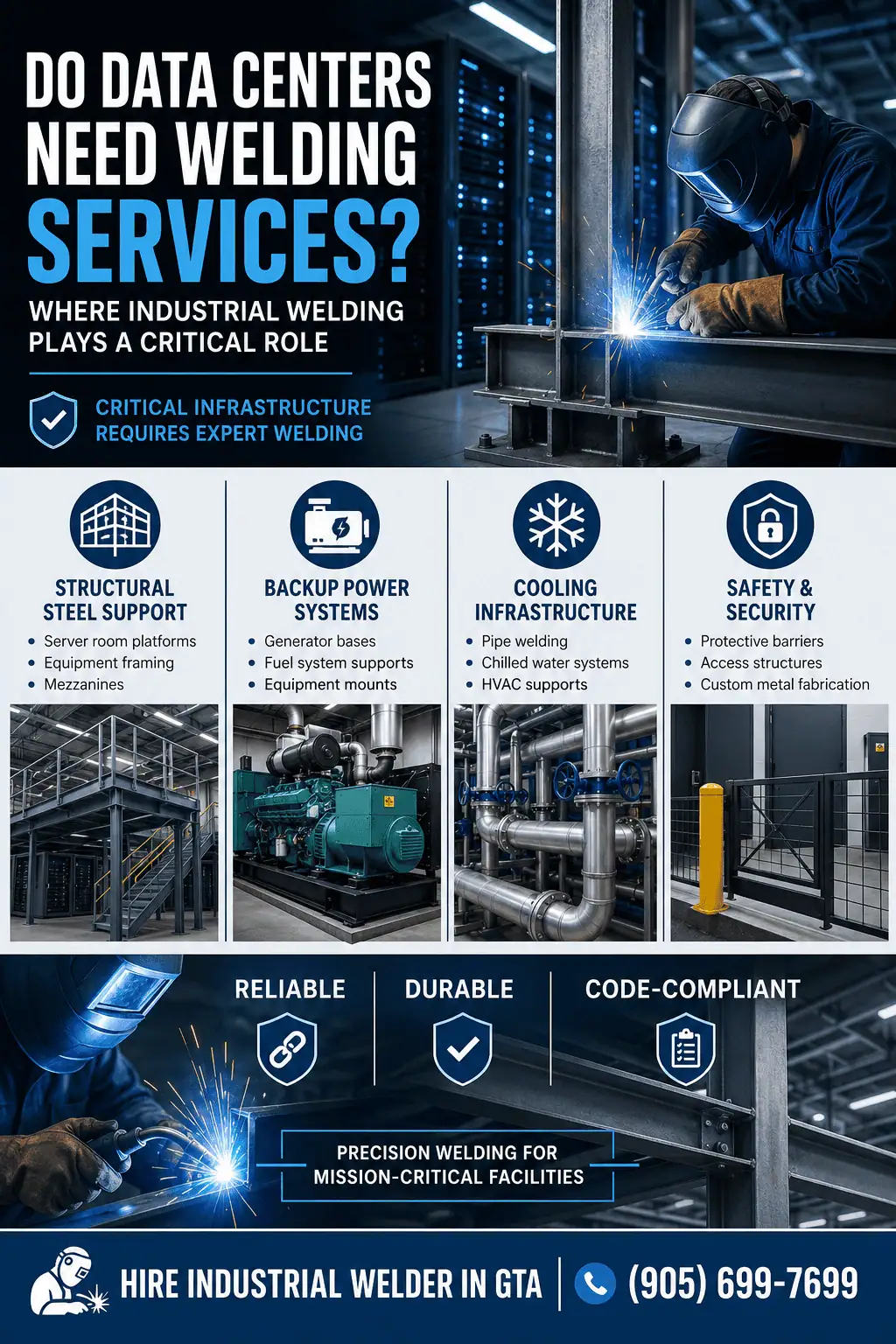
infographic showing importance of industrial welding in data centers in Ontario

3. Custom Metal Fabrication: Tailoring the Internal Infrastructure

Apart from the main structural and mechanical components, the interiors of data centers require a great deal of bespoke metal fabrication. This is to ensure the best possible use of the available space, optimized heat dissipation, and the provision of physical security. In most instances, bespoke metal fabrication is required to use the spaces where standard, off-the-shelf metal fabrication products cannot:

Infrastructure Domain Technical Challenge Engineered Fabrication Solution
Modular MEP Skids Integrating dense mechanical, electrical, and plumbing runs into ultra-compact pathways. Heavy-duty, structural steel frame enclosures engineered for drop-in field installation and structural rigidity.
High-Volume Cable Runways Managing thousands of fiber and copper lines while preventing localized heat stagnation. Custom overhead cable tray networks, containment systems, and custom drops designed to optimize airflow dynamics.
Critical Power Enclosures Protecting external generators, switchgear, and UPS systems from environmental hazards and noise pollution. Heavy-gauge, weather-sealed, and acoustically dampened custom sheet metal housings tailored to exact equipment dimensions.

Custom metal fabrication provides the necessary metal structural supports for modern, data-driven buildings.

4. The Lifecycle Support: Welding Services for Data Center Maintenance

The collaboration and partnership with an industrial welding specialist continues well beyond the construction phase. Arguably, the reliable welding services for Data Center maintenance is an essential requirement to ensure the safety of the facility’s continued operations, and to avoid expensive downtime.

Typical welding maintenance, both routine and unscheduled, primarily involves:

  • Cooling Loop Upgrades: Replacement and/or the addition of new, chilled water lines to facilitate the increased cooling demands when older cooling racks are removed and replaced with newer, liquid-cooled cooling racks.
  • Structural Retrofitting: Strengthening existing floor systems and structural bays to support unexpected additional weight during renovations of the facility.
  • Vibration and Fatigue Mitigation: Inspecting welded support brackets subjected to micro-vibrations of large HVAC fans, pumps, and generators, and repairing compromised joints.

Data centers are designed to provide 99.999% uptime. Therefore, most welding is carried out in a “live environment.” This requires certified mobile teams who have received advanced training to ensure that localized welding activities (such as heat, smoke, electrical perturbations, and other interferences) do not interfere with the delicate functions of the server room, which is in close proximity and active.

Partnering with the Right Welding Experts in Ontario

With the rapid proliferation of tech industries across the province, partnering with the right Ontario welding experts is becoming more essential than ever.

At Minhas Mobile Welding, we offer certified, precision structural steel welding, precise pipe welding, and custom metal fabrication tailored for critical industrial applications.

Our experienced mobile units bring certified expertise directly to your site, whether you are expanding a new hyperscale facility or need emergency repairs.

Check out Minhas Mobile Welding’s Specialized Industrial Solutions to ensure your data center infrastructure is durable, code-compliant, and fully prepared for any future maintenance needs to maximize your uptime.
Related Posts:

How Mobile Welding Companies in GTA Handle Complex 6G Pipe Repairs

Professional 6G Pipe Welding in GTA

A damaged pipe weld can bring an entire operation to a standstill, making 6G pipe repairs & welding an urgent priority for many businesses. Whether it happens at a manufacturing facility in Mississauga, a construction site in Toronto, or an agricultural operation outside Hamilton, unexpected pipe failures often lead to downtime, safety concerns, and costly delays.

For businesses that depend on piping systems to transport liquids, gases, or process materials, every hour of downtime matters. In many cases, moving damaged equipment to a welding shop is not practical. Large industrial systems, structural piping networks, and field-installed pipe assemblies often require repairs where they are located.

How GTA Welders Handle 6G Pipe Repairs?

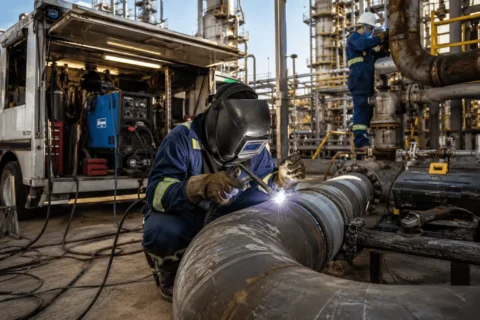
This is where 6G Welding plays an important role. Known as one of the most challenging welding positions in the industry, 6G pipe welding requires a high level of skill, precision, and experience. Mobile welding companies that specialize in complex pipe repairs can perform critical welding work directly on-site, helping businesses restore operations while minimizing disruption.

Understanding how mobile welding companies approach complex 6G Pipe Welding Services can help property managers, contractors, facility operators, and equipment owners make informed decisions when pipe failures occur.

Understanding the Problem

What Is 6G Welding?

6G Welding refers to a pipe welding position where the pipe is fixed at approximately a 45-degree angle and cannot be rotated during welding. The welder must work around the pipe while maintaining consistent weld quality throughout the entire joint.

This position is widely recognized as one of the most demanding welding tests and real-world applications because it combines multiple welding positions into a single weld.

Why Do Pipe Weld Failures Occur?

Pipe weld failures can develop for several reasons, including:

  • Corrosion and rust
  • Vibration from equipment operation
  • Thermal expansion and contraction
  • Material fatigue
  • Improper installation
  • Environmental exposure
  • Heavy industrial usage
  • Impact damage from machinery

In commercial and industrial environments throughout the GTA, piping systems are often exposed to demanding conditions that increase wear over time.

Common Warning Signs

Property owners and facility managers should watch for:

  • Visible cracking around welds
  • Rust formation near welded joints
  • Fluid leaks
  • Pressure loss
  • Unusual vibrations
  • Discoloration around weld areas
  • Repeated maintenance issues

Identifying these signs early can help prevent larger failures and emergency shutdowns.

Why This Happens in Ontario?

Ontario presents unique challenges for piping systems and welded structures.

Freeze-Thaw Cycles

During winter, temperatures can fluctuate significantly. Water trapped in small cracks may freeze and expand, increasing stress on existing welds. Repeated freeze-thaw cycles can gradually weaken welded joints.

Road Salt and Corrosion

Commercial fleets, industrial equipment, and outdoor piping systems are frequently exposed to road salt and de-icing chemicals. These materials accelerate corrosion and can reduce the lifespan of welded components.

Heavy Industrial Use

Southern Ontario remains one of Canada’s busiest industrial regions. Manufacturing plants, warehouses, logistics facilities, and construction projects place constant demands on piping systems and welded assemblies.

Aging Infrastructure

Many commercial and industrial facilities across the GTA continue to operate with aging systems. Over time, welds experience stress from years of service, increasing the likelihood of repairs becoming necessary.

Seasonal Construction Demands

Construction projects in Toronto, Vaughan, Markham, and surrounding areas often operate under tight schedules. Pipe failures during critical project phases can quickly create costly delays if repairs are not completed promptly.

Risks of Ignoring the Problem

Ignoring damaged pipe welds can create serious consequences.

Safety Hazards

Cracked or failed welds can result in leaks, structural instability, or equipment malfunctions. In industrial environments, these issues may create risks for workers and site operations.

Increased Repair Costs

Small defects are generally less expensive to repair than complete system failures. Delaying repairs often allows damage to spread, increasing both labor and material costs.

Production Downtime

Manufacturing facilities and warehouses rely on uninterrupted operations. Pipe failures can halt production lines and affect delivery schedules.

Construction Delays

A failed weld on a construction site may prevent progress on multiple tasks. Delays can impact subcontractors, project timelines, and overall budgets.

Equipment Damage

Leaks and pressure loss can affect pumps, valves, compressors, and connected equipment, resulting in additional repair expenses.

Compliance Concerns

Commercial and industrial facilities may be required to maintain equipment that meets safety and operational standards. Unaddressed weld defects can create compliance issues during inspections.

Which Solutions is Ideal For You?

When pipe weld damage occurs, several options may be available depending on the severity of the issue.

Repair Existing Welds

In many situations, damaged sections can be repaired without replacing the entire system.

Advantages:

  • Lower cost
  • Faster turnaround
  • Reduced disruption

Limitations:

  • Not suitable for extensive damage
  • May require additional inspections

Full Replacement

Severely damaged piping may require replacement.

Advantages:

  • Long-term solution
  • Opportunity for upgrades

Limitations:

  • Higher cost
  • Longer downtime

In-Shop Welding

Some components can be removed and repaired in a welding facility.

Advantages:

  • Controlled environment
  • Specialized equipment access

Limitations:

  • Transportation costs
  • Equipment removal required

Mobile Welding Repairs

Mobile welding crews perform 6G pipe repairs directly at the site.

Advantages:

  • Minimal disruption
  • Faster response times
  • Reduced transportation needs

Limitations:

  • Weather conditions may affect scheduling
  • Site accessibility requirements

Fabrication and Reinforcement

In some situations, reinforcing existing pipe systems or fabricating replacement sections may provide the most practical solution.

When On-site Welding Makes Sense?

There are many situations where on-site welding offers clear advantage over welding shops near you.

Emergency Breakdowns

Unexpected failures rarely happen at convenient times. Mobile welders can respond directly to commercial, industrial, and agricultural sites to address urgent repairs.

Large Industrial Systems

Many industrial piping networks cannot be easily dismantled or transported. On-site welding eliminates the need for extensive disassembly.

Construction Projects

When schedules are tight, transporting components off-site may not be practical. Mobile welding helps maintain project momentum.

Heavy Equipment Repairs

Construction equipment, processing systems, and specialized machinery often require repairs where they are operating.

Farm Equipment During Peak Seasons

For Ontario farmers, equipment downtime during planting or harvest can have significant consequences. Mobile welding repairs can help restore critical equipment quickly.

Structural and Facility Repairs

Pipe supports, industrial frameworks, and connected steel components may require welding work alongside pipe repairs. Mobile welding teams can address multiple issues during a single visit.

What to Expect During the Process?

Understanding the repair process helps facility managers and property owners prepare effectively.

Initial Inspection

The welding team evaluates the damaged area and identifies the cause of the failure.

This may include:

  • Visual inspections
  • Weld condition assessment
  • Material evaluation
  • Safety reviews

Repair Planning

A repair strategy is developed based on:

  • Material type
  • Pipe thickness
  • Accessibility
  • Operating requirements
  • Environmental conditions

Site Preparation

Before welding begins, the area is prepared to ensure safe working conditions.

This may involve:

  • Cleaning the weld zone
  • Removing damaged material
  • Establishing safe access
  • Protecting nearby equipment

Welding Operations

During 6G Welding repairs, welders must carefully control:

  • Heat input
  • Joint alignment
  • Weld penetration
  • Weld consistency

Because the pipe remains fixed, welders continuously adjust their body position while maintaining quality throughout the weld.

Quality Checks

After welding is completed, inspections verify that repairs meet project requirements.

Checks may include:

  • Visual examination
  • Dimensional verification
  • Surface evaluation
  • Additional testing when required

Project Completion

The repaired system is reviewed and prepared for return to service, helping minimize operational disruptions.

Steps to Prevent Future Problems

While not all failures can be prevented, proper maintenance significantly reduces risk.

Schedule Regular Inspections

Routine inspections can identify small defects before they become major failures.

Address Corrosion Early

Remove rust and apply protective coatings where appropriate.

Monitor High-Stress Areas

Pay special attention to:

  • Pipe supports
  • Connection points
  • High-vibration equipment
  • Outdoor systems

Maintain Protective Finishes

Protective coatings help shield metal surfaces from moisture and environmental exposure.

Investigate Minor Leaks

Even small leaks may indicate larger underlying problems that require attention.

Prepare for Winter Conditions

Ontario winters can place additional stress on piping systems. Seasonal inspections before freezing temperatures arrive can help identify vulnerabilities.

Work With Qualified Welding Professionals

Complex pipe repairs require experienced welders who understand proper procedures, material requirements, and safety considerations.

Conclusion

Complex pipe weld failures can create significant challenges for businesses, contractors, property managers, and equipment owners across Ontario. Understanding the causes of weld damage, recognizing early warning signs, and addressing issues promptly can help reduce safety risks, minimize downtime, and control repair costs.

Because 6G Welding requires a high level of skill and precision, choosing experienced professionals is critical when repairs involve fixed-position pipe systems. Whether the issue occurs at a construction site, manufacturing facility, commercial property, or agricultural operation, timely repairs often make the difference between a manageable repair and a costly shutdown.

Whether you need emergency welding repairs, structural welding, 6G Pipe Welding Services, or on-site fabrication anywhere in the GTA, working with experienced mobile welders can help reduce downtime and keep your project moving.

Frequently Asked Questions

What makes 6G Welding more difficult than other welding positions?

6G Welding requires welding around a fixed pipe positioned at a 45-degree angle. Because the pipe cannot be rotated, the welder must continuously adjust position while maintaining consistent weld quality throughout the entire joint.

When are 6G Pipe Welding Services typically required?

These services are commonly used in industrial facilities, manufacturing plants, construction projects, processing systems, structural piping installations, and equipment repairs where high-quality pipe welds are required.

Can 6G pipe welding repairs be completed on-site?

Yes. Many mobile welding companies perform 6G pipe welding repairs directly at commercial, industrial, and agricultural sites, reducing downtime and eliminating transportation requirements.

How long do pipe welding repairs usually take?

Repair times vary depending on pipe size, material, accessibility, environmental conditions, and the extent of the damage. Simple repairs may be completed within hours, while complex projects may require additional time.

Are winter pipe welding repairs possible in Ontario?

Yes. Experienced mobile welders can perform many repairs during winter conditions. Additional preparation and weather protection measures may be necessary to maintain weld quality.

How can I tell if a pipe weld needs repair?

Common signs include visible cracks, rust around welds, pressure loss, leaks, unusual vibrations, and recurring maintenance issues. Early inspection can help prevent larger failures.

Is repair always better than replacement?

Not necessarily. Minor damage may be repaired effectively, while severe corrosion or structural deterioration may require replacement. An inspection helps determine the most practical solution.

What industries commonly use mobile welding services?

Industries that frequently rely on mobile welding include construction, manufacturing, transportation, warehousing, agriculture, commercial property management, and industrial operations.

On-site Welding for Industrial Facilities in Peel and Halton

On-site Welding for Industrial Facilities

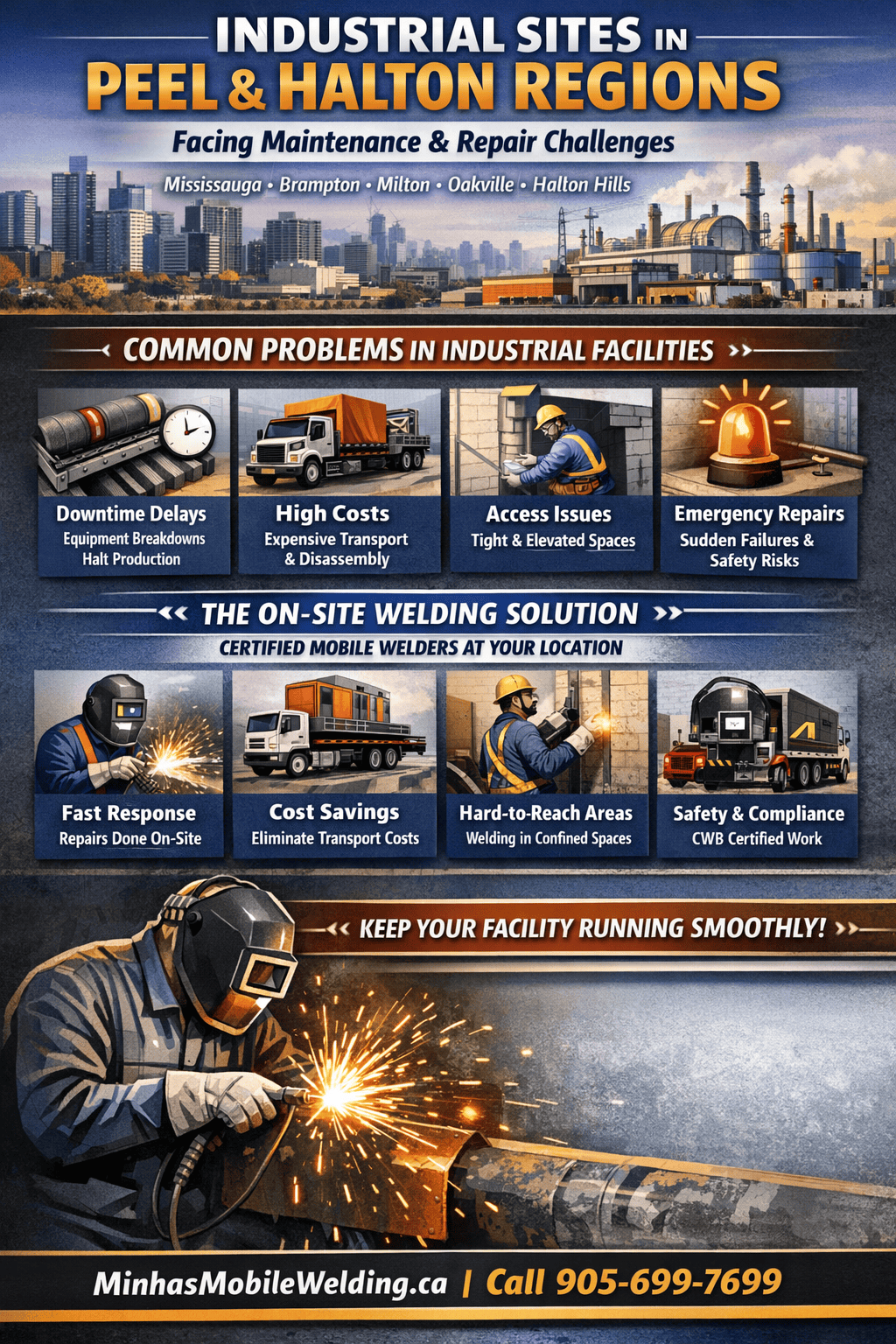
Industrial facilities in the Peel and Halton regions of Ontario form a vital part of the Greater Toronto Area’s manufacturing and logistics backbone. These regions feature many advanced manufacturers, food processors, automotive suppliers, warehouses, distribution centers, and heavy industrial facilities. With major hubs in Mississauga, Brampton, Milton, Oakville, Halton Hills, and surrounding communities, businesses here operate in highly competitive environments where equipment reliability and production continuity are non-negotiable.

A Backbone of Industry That Demands Reliable On-Site Welding

Ontario’s manufacturing sector employed around 830,000 workers in 2024, representing about 10.3% of the province’s total employment and nearly half of Canada’s manufacturing jobs. In the broader Toronto region (which includes Peel), manufacturing supports hundreds of thousands of positions, while Halton Region alone had over 246,000 total jobs identified in recent surveys, with manufacturing remaining a key contributor—particularly in areas like Halton Hills, where advanced manufacturing accounts for about 20% of local employment and includes roughly 115 companies employing around 3,000 people in that sub-sector.

In such settings, on-site welding (also called mobile welding or on-spot welding) has become an essential service for maintenance, repairs, and modifications. Certified industrial welders comes at your facility with equipped vehicles, performing welding jobs without removing components or structures*. This approach addresses many operational realities unique to large-scale industrial operations.

Common Problems in Industrial Maintenance and Repair

Industrial facilities face several recurring challenges when dealing with metal components, structural elements, machinery, and piping systems.

Extended Downtime from Equipment Breakdowns

A failed conveyor frame, cracked pressure vessel support, or damaged structural beam can halt entire production lines. Unplanned downtime in manufacturing can be extremely expensive; studies indicate average costs in Canada reach around $242,000 per hour for unplanned outages in industrial settings, with global benchmarks sometimes citing figures as high as $260,000 per hour across businesses. Transporting heavy or fixed equipment to an off-site shop often takes days or weeks, leading to lost output, delayed shipments, and revenue impacts.

High Costs of Disassembly and Transportation

Removing large parts, loading them onto trucks, and hauling them to fabrication shop in close areas incurs significant expenses. There’s also the risk of additional damage during transit or handling.

Logistical Constraints in Confined or Elevated Spaces

Many repairs occur in tight areas, at heights, or within operating plants where access is limited. Traditional shop-based welding doesn’t accommodate these realities well.

Emergency Situations and Unexpected Failures

Sudden issues like cracked frames on heavy machinery or failed welds on safety railings demand immediate attention to prevent safety hazards or regulatory violations.

Quality and Compliance Risks

Off-site work can introduce variables like mismatched materials or delayed inspections, potentially compromising structural integrity or failing to meet standards such as those from the Canadian Welding Bureau (CWB).

These issues are especially pronounced in Peel and Halton, where facilities often run 24/7 shifts and rely on just-in-time processes.

How On-Site Welding Provides Effective Solutions

On-site welding directly tackles these challenges by bringing skilled, equipped professionals and processes to the facility.

  • Minimized Downtime and Faster Turnaround Repairs

    Repairs happen in place, often within hours rather than days. Industry insights show that proactive, on-site approaches—including mobile welding and related maintenance—can reduce unscheduled downtime by up to 30% in some sectors. For example, a manufacturing plant in Mississauga or a distribution center in Milton can have a welder address a broken conveyor support during a scheduled maintenance window or emergency shutdown, allowing production to resume quickly. This rapid response keeps operations moving and protects bottom-line performance.

  • Significant Cost Savings

    Eliminating transportation and disassembly reduces labor, equipment rental, and logistics expenses. Businesses avoid the indirect costs of prolonged downtime, such as overtime for catch-up work or penalties from supply chain delays. In high-volume industrial zones like Halton Hills or Brampton, these savings accumulate meaningfully over time.

  • Flexibility for Complex or Inaccessible Repairs

    Mobile units handle work in confined spaces, elevated platforms, or live facilities using portable equipment for processes like TIG, MIG, or stick welding on materials including steel, stainless steel, and aluminum. This adaptability suits the diverse needs of regional plants, from structural reinforcements in warehouses to pipe repairs in processing facilities.

  • Enhanced Safety and Compliance

    On-site services allow real-time assessments and adjustments, ensuring welds meet Canadian safety standards and codes. Many providers in the GTA, including those serving Peel and Halton, offer CWB-certified welders who prioritize proper preparation, ventilation, and hazard controls. Immediate repairs to safety features, like guardrails or structural supports, help maintain workplace safety and avoid incidents.

  • Custom Modifications and Proactive Maintenance

    Beyond fixes, on-site welding supports upgrades, such as adding reinforcements or fabricating custom brackets without disrupting the full operation. This proactive approach extends equipment life and prevents future breakdowns.

In Peel and Halton, numerous experienced mobile welding providers includng Minhas, serve these industrial corridors, offering 24/7 emergency response and specialized services for manufacturing, heavy equipment, and structural needs. Their presence reflects the region’s emphasis on efficient, localized support for its industrial ecosystem.

The Bottom Line

For industrial operators in Peel and Halton, on-site welding represents a practical, high-impact solution in an environment where every hour of uptime counts. By addressing downtime, costs, access issues, and compliance head-on, it enables facilities to maintain productivity, safety, and competitiveness. When equipment breaks or needs changes, hiring a mobile welder on-site is usually the fastest, smartest solution.

Frequently Asked Questions

On-site welding excels for structural repairs, machinery fixes, pipe welding, conveyor modifications, safety railing restorations, and custom fabrications in factories, warehouses, and processing plants. It’s particularly valuable where components are too large, fixed, or disruptive to move.

Certified mobile welders use the same professional techniques and equipment as shop-based services, often with CWB certification. On-site work allows direct oversight, immediate adjustments, and real-time inspections, reducing risks from transport or delays.

Yes, when performed by trained professionals who follow strict safety protocols—including proper ventilation, fire prevention, PPE, and hazard isolation. Many services prioritize minimal disruption and comply with Ontario regulations to protect workers and operations.

Look for CWB-certified welders with industrial experience, 24/7 availability for emergencies, well-equipped mobile units, positive references from local facilities, and insurance coverage. Proximity to Peel and Halton ensures faster response times.

Many providers in the GTA, including those serving Peel and Halton, offer emergency and after-hours service for urgent issues like equipment failures that threaten production or safety.