6G welding is one of the most complex and advanced welding techniques, primarily used in the welding of pipes. It is a skill that demands precision, expertise, and a deep understanding of welding fundamentals. In this blog post, we’ll explore what 6G welding is, its applications, and the importance of 6G Pipe Welding (X-Ray) inspection.
What is 6G in Welding?
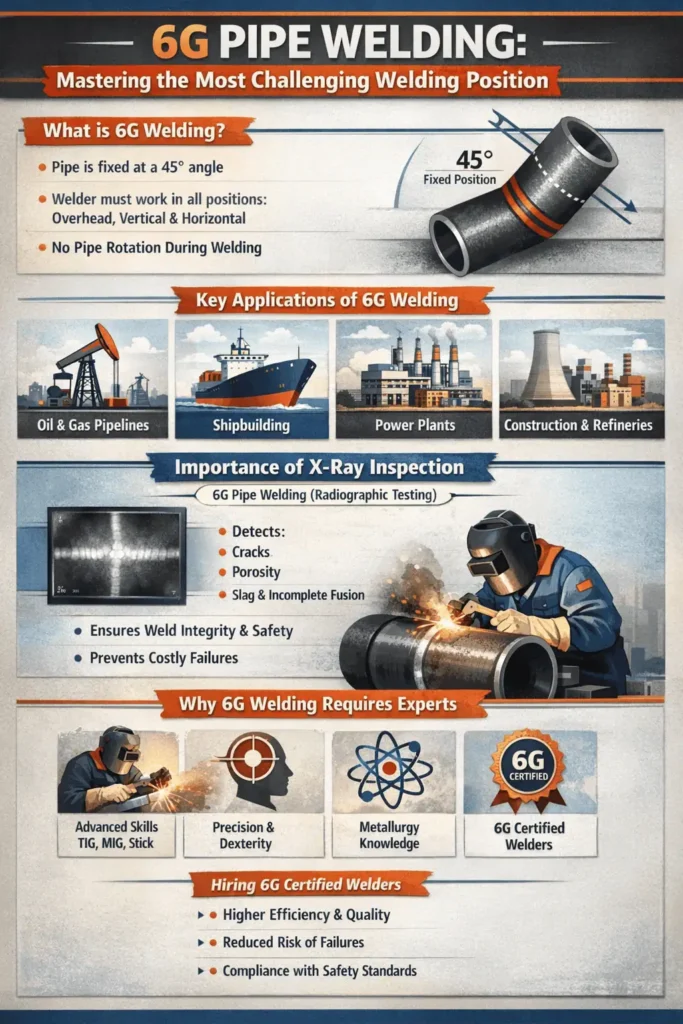
6G welding refers to a welding position where the pipe is fixed at a 45-degree angle. The “6” in 6G stands for the position, and “G” stands for a groove weld. Unlike some other positions, the welder does not rotate the pipe during the welding process. This means the welder must be able to handle multiple challenging angles—overhead, vertical, and horizontal—all in one go.
Also read: Welding Positions and Joint Types 1G, 2G, 3G, 4G, 5G, and 6G
This fixed position makes 6G welding one of the most challenging types of welding job. Welders need to continually adapt their torch angle, travel speed, and technique based on the pipe’s orientation to ensure a consistent and high-quality weld around the entire circumference.
Applications of 6G Welding
6G Pipe Welding is widely used in industries where pipe welding is critical, such as:
- Oil and Gas: Pipelines in the oil and gas industry often require 6G welding due to the need for strong and reliable joints that can withstand high pressures and harsh environmental conditions.
- Shipbuilding: In shipbuilding, welders use 6G welding to weld pipes and structural components that cannot be rotated. Precision is essential for safety and durability.
- Power Plants: Power plants depend on 6G welding for assembling high-pressure pipelines, boilers, and pressure vessels—ensuring the welds hold up under extreme conditions.
- Construction: For large-scale infrastructure projects involving plumbing or industrial piping systems, 6G welding plays a central role in maintaining the integrity and reliability of pipelines.
- Refineries and Chemical Plants: These facilities rely heavily on 6G-certified welders to ensure pipe systems handle volatile substances without leaks or failure.
The Importance of 6G in Pipe Welding (X-Ray)
After welding, it’s vital to inspect the welds to ensure they meet industry standards and safety codes. One of the most accurate and non-invasive inspection methods is 6G Pipe Welding (X-Ray), also known as radiographic testing (RT).
X-ray inspection uses radiographic technology to capture detailed images of the interior weld. This allows inspectors to evaluate the weld’s integrity without damaging the pipe. It can detect internal flaws such as:
- Cracks
- Porosity
- Slag inclusions
- Incomplete fusion
- Burn-through
These types of defects might be invisible to the naked eye but can lead to catastrophic failure if undetected. In high-risk environments like oil refineries or gas pipelines, a single weld failure could result in costly downtime, environmental disasters, or even loss of life. That’s why X-ray inspections are standard practice in critical industries.
Why 6G Welding Requires Skilled Experts
The complexity of the 6G position means that only highly trained and experienced welders can perform it effectively. Mastery of this technique requires:
- Deep understanding of multiple welding processes (TIG, MIG, Stick)
- Manual dexterity and hand-eye coordination to maintain precision at awkward angles
- Adaptability to work in different positions and settings
- Knowledge of metallurgy and filler materials for different pipe types
Many employers in industrial sectors require welders to hold 6G welding certifications, which typically involve hands-on practical testing and theoretical exams. These certifications (e.g., from AWS or ASME) are a testament to a welder’s competence in the most demanding of welding environments.
Benefits of Hiring 6G Certified Welders
Employers benefit immensely from hiring certified 6G welders. The advantages include:
- Higher project efficiency – certified welders work faster with fewer errors
- Reduced risk of failure – better technique and higher quality welds
- Compliance with safety standards – ensuring industry regulations are met
- Lower long-term costs – fewer repairs, rework, or accidents
Final Thought
6G welding is a critical skill in industries where pipe welding is essential. The complexity of 6G welding demands a high level of expertise, and the significance of 6G Pipe Welding (X-Ray) inspection is crucial. Whether it’s in the oil and gas sector, shipbuilding, or power plants, it ensures that welded joints are strong, reliable, and safe.
Understanding the intricacies of 6G welding helps industry professionals, inspectors, and decision-makers uphold the highest standards of safety and quality. As infrastructure ages and demand grows for energy and manufacturing, the role of skilled 6G welders becomes more important than ever. Investing in qualified professionals and proper inspection methods isn’t just good practice—it’s essential for long-term operational success.
Frequently Asked Questions
What is 6G welding and why is it considered the most difficult welding position?
6G welding is a pipe welding position where the pipe is fixed at a 45-degree angle, and the welder must move around the pipe to complete the weld. This position is considered the most challenging because it combines all other welding positions (flat, horizontal, vertical, and overhead) in a single weld. The welder must constantly adjust their technique, travel speed, and electrode angle as they move around the pipe. Successfully passing a 6G welding test demonstrates that a welder has mastered all welding positions and can handle any welding scenario in the field.
What are the standard welding positions and how are they classified?
Welding positions are classified by the Canadian Welding Society (CWS) and include:
- 1G (Flat position): The pipe rotates while the welder remains stationary, welding is performed from the top
- 2G (Horizontal position): The pipe is positioned vertically, and welding is performed horizontally around the pipe
- 5G (Horizontal fixed position): The pipe is horizontal and fixed, requiring the welder to weld in all positions by moving around the pipe
- 6G (Inclined fixed position): The pipe is fixed at a 45-degree angle, combining all welding positions and requiring the most skill
For plate welding, positions include 1F/1G (flat), 2F/2G (horizontal), 3F/3G (vertical), and 4F/4G (overhead).
How do I prepare for a 6G pipe welding certification test?
Preparation for a 6G certification test involves several key steps. First, ensure you have extensive practice on all basic welding positions (1G, 2G, and 5G) before attempting 6G. Practice maintaining consistent bead appearance, proper penetration, and fusion throughout the entire joint. Focus on controlling your electrode angle and arc length as you transition between positions. Study the specific welding procedure specification (WPS) you'll be tested on, including acceptable filler materials, amperage settings, and travel speeds. Practice root passes, fill passes, and cap passes separately until you're confident. Finally, understand the acceptance criteria for the test, including allowable defects, bend test requirements, and visual inspection standards.
What is the difference between 6G welding and 6GR welding?
The primary difference is that 6GR includes a restriction ring. In standard 6G welding, the pipe is fixed at a 45-degree angle and the welder has relatively free access to all areas of the joint. In 6GR welding, a restriction ring or barrier is placed around the pipe to simulate confined space conditions, such as welding pipes close to walls, ceilings, or other structural obstacles. This restriction limits the welder's movement and accessibility, making it even more challenging than standard 6G. The 6GR certification demonstrates that a welder can perform quality welds even in tight, restricted spaces commonly encountered in industrial and construction settings.
What are the most common mistakes welders make when attempting 6G pipe welding?
Common mistakes include inconsistent travel speed as they move around the pipe, which leads to uneven bead appearance and potential defects. Many welders struggle with maintaining proper electrode angle when transitioning from the overhead position to the vertical positions. Inadequate root penetration, especially in the overhead portions, is another frequent issue. Welders often fail to adjust their amperage or technique when moving between positions, leading to either burn-through in the overhead sections or lack of fusion in other areas. Poor body positioning and ergonomics cause fatigue and inconsistent welds. Additionally, insufficient cleaning between passes can trap slag and cause inclusions. Taking the time to properly position yourself, maintain consistent technique, and thoroughly clean between passes helps avoid these common pitfalls.
What welding processes are typically used for 6G pipe welding certification?
The most common welding processes for 6G certification include SMAW (Shielded Metal Arc Welding or "stick welding"), GTAW (Gas Tungsten Arc Welding or "TIG welding"), and GMAW (Gas Metal Arc Welding or "MIG welding"). SMAW is the most traditional and widely used process for 6G testing because it's versatile and doesn't require external shielding gas, making it ideal for field conditions. GTAW is often used for the root pass due to its precision and clean welds, especially on stainless steel and high-alloy materials. GMAW is increasingly popular for production welding but less common for certification tests. Some certifications combine processes, such as using GTAW for the root pass and SMAW for fill and cap passes. The specific process depends on the industry requirements, material type, and the certification standard being followed.
How long does it typically take to learn 6G pipe welding and become certified?
The time required varies significantly based on prior welding experience and the intensity of training. For someone with basic welding knowledge, it typically takes 3 to 6 months of dedicated practice and training to become proficient enough to pass a 6G certification test. Complete beginners may need 6 to 12 months or longer, as they must first master fundamental welding skills and progress through easier positions. Professional welding schools often offer intensive programs ranging from several weeks to several months. However, learning the technique is just the beginning; developing the consistency and quality required to pass certification tests requires significant practice time. Even after certification, many welders continue to refine their skills throughout their careers. The key is consistent practice, quality instruction, and patience with the learning process.