Walk into any serious facility, a food plant at sunrise, a pharmaceutical cleanroom humming at midnight, or a chemical line pushing product 24/7, and you’ll notice something most people overlook. Miles of pipes stretch overhead and underfoot, running like arteries through the building beneath the construction. They can look quiet and passive, almost boring. But the reality is far more critical. These lines carry everything that keeps the operation alive, steam, purified water, solvents, gases, CIP chemicals, and product batches worth thousands per minute. That is why industrial pipe welding matters so much. One weak weld and the entire system becomes a liability, leading to leaks, contamination, shutdowns, and failed inspections.
Why Leak-Proof Industrial Pipe Welding Matters More Than Ever
In industrial environments, leaks aren’t small problems. They snowball.
A pinhole in a sanitary line can contaminate an entire batch. A faulty process weld can introduce bacteria, trap residue, or weaken under pressure cycles. A failed joint during inspection can stall production and trigger expensive rework.
And regulators don’t care if it was “almost right.”
They care if it passes.
That’s why experienced welding and fabrication teams treat every welding joint like it’s mission-critical, because it is.
Good pipe welding protects:
- Product quality
- Worker safety
- Equipment longevity
- Regulatory compliance
- Project timelines
Bad pipe welding? It eats all of that alive.
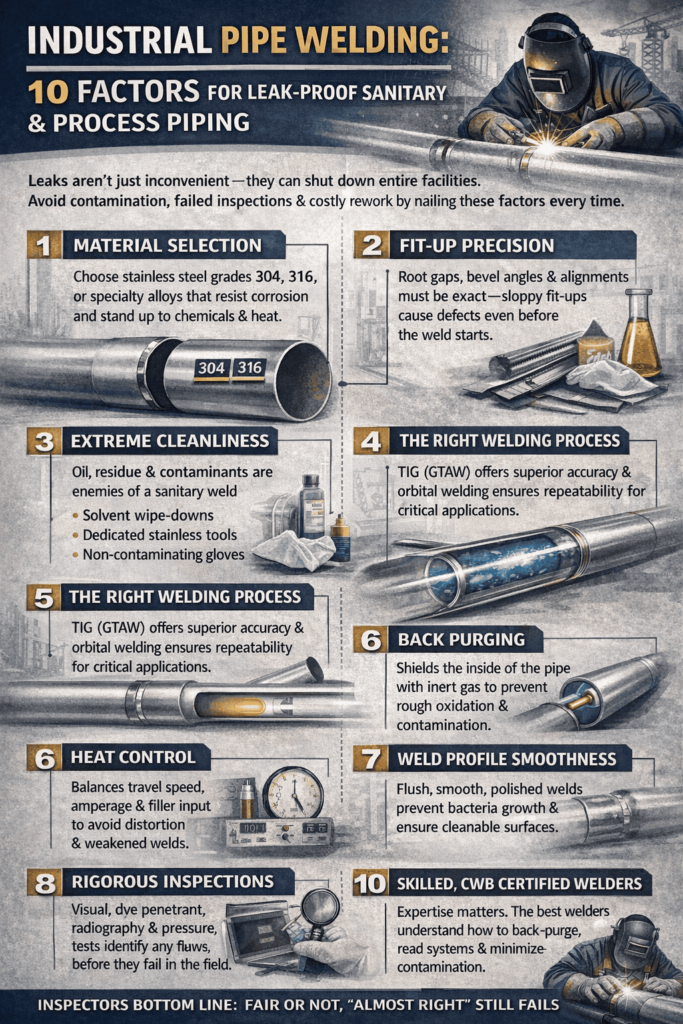
10 Factors Behind Leak-Proof Sanitary & Process Piping
These are the non-negotiables. Skip one, and you’re gambling.
1. Material Selection That Matches the Environment
Before the first arc strikes, the battle is already half decided. Process piping fabrication and installation in Ontario often relies on stainless steel, 304, 316, or specialty alloys, because corrosion resistance and cleanability matter. But not all grades behave the same under heat, chemicals, or pressure.
Choose wrong, and you get pitfalls like Premature corrosion, Stress cracking, Pitting and Contamination risks. Professional fabricators evaluate temperature ranges, chemical exposure, washdown procedures, and mechanical loads before selecting material. Because the strongest weld in the world can’t save the wrong metal.
2. Fit-Up Precision (Where Most Problems Begin)
Here’s a reality most people don’t talk about:
- Weld failures usually start before welding.
- Poor fit-up is the silent saboteur.
- Gaps too wide. Edges misaligned. Oval pipe ends. Uneven bevels.
All of these force welders to “fill problems” instead of making clean fusion. And once you start compensating, quality drops.
Proper pipe preparation means:
- Accurate bevel angles
- Tight, consistent root gaps
- Perfect alignment
- Clean, burr-free edges
When the fit is right, the weld almost flows itself. When it’s wrong, you’re fighting physics. A mobile industrial welder for boiler pipe repair can offer that.
3. Cleanliness That Borders on Obsession
Sanitary welding is not regular welding with nicer language. It’s stricter. Cleaner. Less forgiving. Any oil, dust, or residue trapped in a joint can create porosity or inclusions. That becomes a leak path or bacterial haven.
Industrial welding services treat cleanliness like a ritual:
- Solvent wipe-downs
- Stainless brushes only
- Dedicated tools
Gloves to prevent contamination It might feel excessive. Until you realize one fingerprint can cost a failed inspection.
4. The Right Welding Process for the Job
Not all welds are created equal, and neither are welding methods. For sanitary and process piping, GTAW (TIG welding) is king.
Why?
Because it offers:
- Superior control
- Clean, precise beads
- Minimal spatter
- Excellent penetration
For critical applications, orbital welding systems take it further. Automated, repeatable, perfectly consistent welds, especially valuable in pharmaceutical or food-grade installations. Manual where skill matters. Automated where consistency rules. Smart teams know when to use each.
5. Back Purging for Internal Protection
This is one of those details that separates amateurs from professionals.
Without back purging, stainless steel oxidizes on the inside of the pipe during welding. That rough, sugary oxidation, called “sugaring”, creates contamination traps and weak spots.
It’s unacceptable in sanitary or high-purity systems.
Back purging uses inert gas to shield the inside of the joint, keeping it clean and smooth.
The result?
A bright, polished internal surface that:
Resists corrosion
Prevents bacteria buildup
Maintains flow efficiency
No purge = no sanitary integrity. Simple.
6. Heat Control & Distortion Management
Too much heat warps pipes. Too little heat weakens fusion. Pipe welding lives in that razor-thin middle ground.
Experienced welders adjust:
- Travel speed
- Amperage
- Filler input
- Cooling intervals
This prevents distortion that could misalign systems or create stress points. Because a perfect bead is useless if the pipe no longer lines up.
7. Weld Profile & Internal Smoothness
Sanitary piping isn’t just about strength, it’s about flow. Internal welds must be smooth. Flush. Almost invisible.
Any ridge or crater becomes a place where:
- Product stagnates
- Bacteria multiply
- Cleaning becomes difficult
The best sanitary welds look like they were grown from the pipe, not added later. Seamless. Subtle. Beautiful in a quiet, industrial way.
8. Inspection & Testing That Leaves No Doubt
Trusting your eyes isn’t enough. Professional welding and fabrication teams use testing to verify every critical joint.
Depending on the system, this might include:
- Visual inspection
- Dye penetrant testing
- Radiography
- Pressure testing
- Leak detection
These steps catch small defects before they become big disasters. Skipping inspection saves hours today and costs weeks tomorrow.
9. Compliance With Industry Standards
Sanitary and process piping often falls under strict codes and guidelines.
Think:
- ASME
- CSA
- Food-grade requirements
- Pharmaceutical standards
These aren’t suggestions. They’re requirements. Experienced welding services understand documentation, traceability, and inspection expectations inside out. That knowledge keeps projects moving instead of stalling at approval time.
10. Skilled Welders Who Read Systems, Not Just Drawings
Here’s the human factor. Technology helps. Procedures matter. But at the end of the day, pipe welding is still a craft. A skilled welder doesn’t just follow instructions, they anticipate problems.
They see:
- Stress points
- Access issues
- Future maintenance needs
- Real-world operating conditions
That foresight prevents failures you’ll never even know almost happened. And honestly? That’s the best kind of success.
Sanitary vs Process Piping: Why the Standards Are Higher
In regular structural welding, a weld simply needs to hold. In sanitary or process piping, it must:
Hold pressure
- Stay sterile
- Resist chemicals
- Allow full cleaning
- Pass inspections
It’s strength plus hygiene plus compliance. That triple demand is what makes industrial pipe welding a specialized discipline, not general fabrication.
When to Hire Professional for Industrial Welding Services
If your piping handles:
- Food or beverage
- Pharmaceuticals
- Chemicals
- Steam or pressure systems
- Inspection-critical production
- This isn’t DIY jobs.
Certified welding and fabrication services bring the experience, procedures, and accountability needed to protect your operation. Because fixing leaks after startup is always more expensive than getting it right the first time.
Final Thoughts
Industrial pipe welding might not look glamorous. It’s sparks, steel, and long hours under hard hats.
But behind those sparks is something powerful: reliability. When the welds are right, everything flows. Production runs smoothly. Inspections pass. Nobody thinks about the pipes.
And that’s the goal.
The best piping systems are invisible.
No leaks, drams or late-night emergency calls.
Just quiet, dependable performance, day after day, year after year. That’s what precision welding delivers. And that’s what separates ordinary fabrication from true industrial craftsmanship.
Frequently Asked Questions
What's the difference between regular welding and sanitary pipe welding?
Regular welding focuses primarily on structural strength, making sure the joint holds under load. Sanitary pipe welding demands much more: the weld must maintain pressure integrity, resist chemical corrosion, stay completely sterile, allow thorough cleaning, and pass strict regulatory inspections. It combines strength with hygiene and compliance, requiring specialized skills, cleaner work environments, and processes like back purging to prevent internal contamination. The stakes are higher because these welds directly impact product quality and safety.
Why is back purging so critical in stainless steel pipe welding?
Without back purging, the inside of stainless steel pipes oxidizes during welding, creating a rough, discolored surface called "sugaring." This oxidation becomes a contamination trap where bacteria can multiply and product residue can accumulate. In sanitary systems—especially food, beverage, and pharmaceutical applications—this is unacceptable. Back purging uses inert gas to shield the pipe's interior during welding, resulting in a smooth, bright, corrosion-resistant surface that maintains flow efficiency and sanitary integrity.
How do I know if my facility needs CWB-certified welding services?
If your piping systems handle food, beverages, pharmaceuticals, chemicals, steam, or any pressure-critical processes, certified welding services aren't optional—they're essential. CWB certification ensures welders meet Canadian standards for quality and safety. These systems require documented procedures, material traceability, and often undergo regulatory inspections. Professional certified services bring the expertise to navigate compliance requirements while delivering leak-proof, sanitary welds that protect your operation from costly shutdowns and failed inspections.
What causes most pipe weld failures?
Surprisingly, most weld failures start before the welding even begins. Poor fit-up, misaligned pipes, inconsistent gaps, uneven bevels, or oval pipe ends—forces welders to compensate rather than achieve clean fusion. Other common culprits include contamination from oils or residue, improper material selection for the environment, excessive heat causing distortion, and skipping back purging. That's why experienced fabricators emphasize preparation, cleanliness, and proper procedures as much as the welding technique itself.
Can automated orbital welding replace skilled manual welders?
Orbital welding and manual welding each have their place. Orbital systems excel at delivering perfectly consistent, repeatable welds—especially valuable in pharmaceutical installations or where identical joints are needed throughout a system. However, skilled manual welders remain essential for complex geometries, field repairs, custom fabrications, and situations requiring real-time problem-solving. The smartest operations use both: automation where consistency rules, and experienced craftspeople where adaptability and system-reading skills matter most.
How much does improper pipe welding really cost?
The costs multiply fast. A single leak can contaminate entire product batches worth thousands per minute. Failed inspections stall production and trigger expensive rework that's always more costly than doing it right initially. Premature corrosion shortens equipment lifespan, requiring early replacement. Bacterial contamination risks can lead to recalls, regulatory penalties, and reputation damage. Beyond direct costs, there's downtime—every hour of unplanned shutdown ripples through schedules, deliveries, and customer commitments. Professional welding is an investment that prevents all these cascading failures.
What should I look for when hiring industrial pipe welding services?
Look for certifications (CWB, ASME), but also ask about their specific experience with your industry—food-grade, pharmaceutical, or chemical processing each have unique requirements. Verify they understand compliance standards and documentation needs. Ask about their inspection and testing procedures. Quality fabricators will discuss material selection, fit-up precision, back purging protocols, and heat management without prompting. Check if they have both manual welding expertise and automated orbital capabilities. Most importantly, seek teams that treat every joint as mission-critical, because in industrial environments, they truly are.