For Canadian welders, from the bustling shops of Toronto to the remote pipeline sites in Alberta and the DIY garages in Vancouver, your helmet isn’t just a piece of safety gear; it’s your window to the weld. As we look ahead to 2026, helmet technology has made leaps that dramatically improve comfort, clarity, and control. The latest auto-darkening welding helmets are smarter, clearer, and more feature-rich than ever before.
This comprehensive guide cuts through the marketing to bring you professional, unbiased reviews of the top welding helmets on the market.
We’ve evaluated the latest models, including the highly anticipated Lincoln Electric Viking 2450 and the refined Miller Digital Infinity, focusing on what matters most to welders in Canada.
Unparalleled optical clarity, true-to-life colour technology, and innovative new features like modular LED lighting designed for our unique low-light winter environments.
Whether you’re a professional pipe welder, a metal fabrication artist, or a serious hobbyist, this is your roadmap to finding the perfect helmet for 2026 and beyond.
Why Your Welding Helmet Choice Matters More Than Ever
Choosing the right welding helmet directly impacts your weld quality, productivity, and long-term health. A premium auto-darkening helmet with superior optical clarity reduces eye strain and neck fatigue during those long shifts, allowing you to see the puddle with startling detail.
For Canadians, considerations like battery performance in cold weather and lens durability against humidity and temperature swings are not just details, they’re essentials. The 2026-generation helmets address these challenges head-on, making now an excellent time to upgrade your most critical piece of welding safety equipment.
The 2026 Gold Standard: What We Look For in a Top-Tier Welding Helmet
Before we dive into our top picks, let’s establish the criteria used for our professional reviews. These factors are the benchmark for a best-in-class welding helmet in 2026:
- Optical Clarity (The 1/1/1/1 Standard): This is the non-negotiable foundation. A true 1/1/1/1 optical class rating (as per the EN 379 standard) means minimal angular dependence, no ghosting or distortion, and a perfectly flat view. It’s the difference between guessing and knowing exactly what your weld pool is doing.
- “True Colour” & Viewing Experience: Advanced sensors and liquid crystal technology now aim to replicate natural sight. Helmets with “True Colour” or similar technology filter out the harsh orange/red glare without making everything dark green or blue, preserving contrast and reducing colour fatigue.
- Responsiveness & Shade Range: A fast switching speed (often 1/25,000th of a second or quicker) is vital for avoiding “flash,” especially in tack-welding or shop environments. A wide shade range (e.g., 5-13) offers versatility for low-amperage TIG welding up to high-amperage arc gouging.
- Comfort & Ergonomics for the Long Haul: Weight distribution, headgear adjustability, and overall balance are crucial. A heavy or poorly balanced helmet can lead to significant neck strain over a 10-hour day.
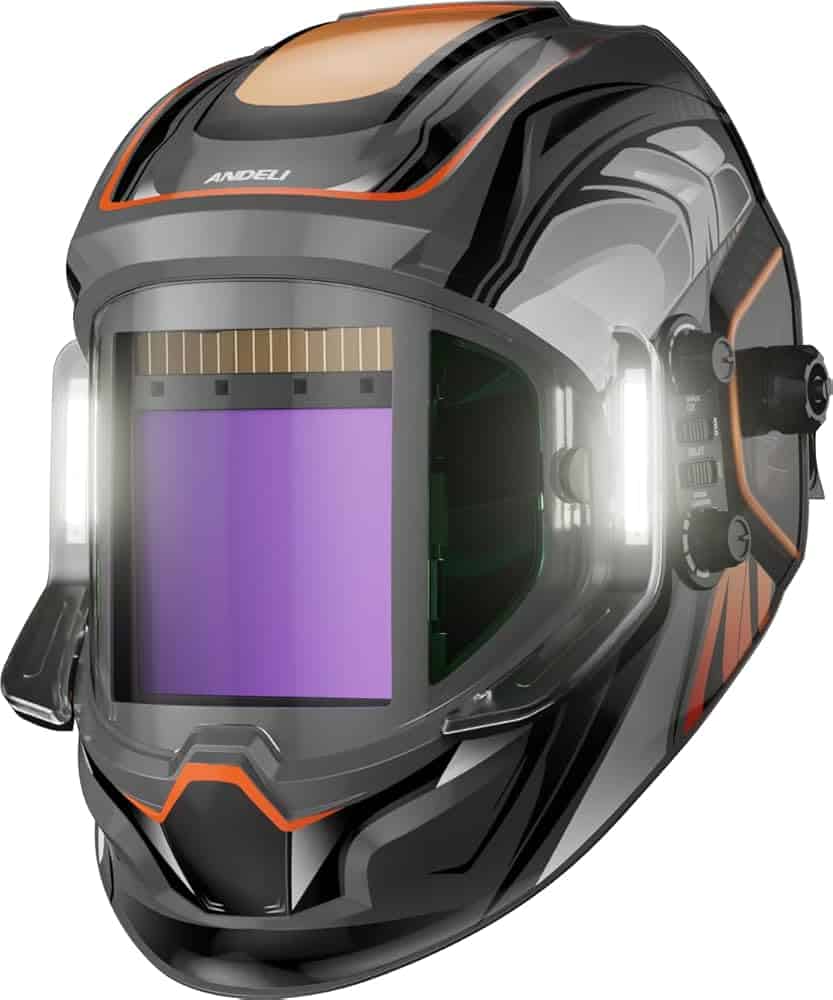
- Durability & Canadian-Ready Features: Can the outer lens cover take a knock? Is the housing resistant to sparks and spatter? Most importantly for us, how does the battery system perform in -20°C? New features like modular LED lighting kits are a game-changer for working inside vessels, under machinery, or during our early dark winter afternoons.
Top Welding Helmet Reviews & Rankings for 2026
After extensive testing and research, here are our top recommendations for Canadian welders.
1. Lincoln Electric Viking 3350 Advanced (2026 Edition)
The Benchmark for Optical Clarity
The Lincoln Viking 3350 has long been a favourite, and the 2026 Advanced edition solidifies its place at the top. It sets the bar for what a clear, comfortable, and reliable welding helmet should be.
- Optical Performance: It boasts a genuine 1/1/1/1 optical class with a massive 35.5 sq. cm viewing area. The “4C™ Lens Technology” provides an exceptionally clear, colour-neutral view that many welders describe as “not even feeling like you’re looking through a lens.”
- 2026 Upgrades: This year’s model features enhanced grind mode detection and improved low-light sensor performance. The big news is its compatibility with Lincoln’s new Modular Task Light System. This magnetic LED light clips seamlessly onto the top of the helmet shell, providing a powerful, hands-free spotlight exactly where you need it, a perfect solution for Canadian winters.
- Ideal choice For: Professional welders across all processes (MIG, TIG, Stick, Flux-Cored) who prioritize optical clarity above all else. It’s ideal for fabrication shops, 6G pipeline welders, and anyone doing precision TIG welding.
- Consideration: The premium features come with a premium price tag, but for full-time professionals, the investment is quickly justified by reduced fatigue and improved weld quality.
2. Miller Digital Infinity with ClearLight™ Lens
The Cutting-Edge Performer
Miller’s Digital Infinity has been a fierce competitor to the Viking, and its 2026 iteration with the exclusive ClearLight™ lens pushes the boundaries of viewing technology.
- Optical Performance: The ClearLight™ lens is Miller’s answer to “True Colour.” It uses a proprietary filter to deliver one of the lightest, most natural colour views on the market, significantly reducing the traditional green tint. The 1/1/1/1 optical clarity is impeccable.
- 2026 Upgrades: Miller has doubled down on digital controls and customization. The four independent arc sensors are now more sensitive, reducing the chance of false triggering. The helmet also supports an innovative wireless integration module (sold separately) that can connect to compatible Miller digital welders for seamless control and data display, a glimpse into the smart shop of the future.
- Best choice for: Tech-savvy welders, those working in highly variable light conditions, and professionals who appreciate extensive digital customization. It’s a superb choice for industrial maintenance and manufacturing.
- Consideration: The advanced digital features have a learning curve, and the lens technology, while spectacular, can be more expensive to replace.
3. ESAB Sentinel A50
The Agile, Feature-Packed Contender
The ESAB Sentinel A50 takes a slightly different approach with a sleek, modern shell design and a focus on ergonomics and versatility. It remains a top contender for 2026.
- Optical Performance: It features a high-quality 1/1/1/2 optical class lens (with a top-tier 1/1/1/1 lens available as an upgrade). The “True Colour” view is excellent, rivalling the top two, especially in its upgraded lens option.
- Standout 2026 Feature: Its greatest strength is its incredibly lightweight and balanced design, along with the Kinetix® Ease headgear, which is widely regarded as one of the most comfortable and easiest to adjust on the market. For 2026, ESAB has improved the solar assist system for faster charging in indirect light.
- Ideal choice For: Welders who suffer from neck strain, or those who are constantly flipping their helmet up and down. Its comfort is unmatched. Also a great choice for all-position welders and metal artists.
- Consideration: The stock lens is a 1/1/1/2, so purists seeking the absolute best clarity will want to budget for the premium lens upgrade.
4. 3M Speedglas 9100 FX Air
The Premium Choice for Respiratory Protection
For welders who prioritize integrated air purification, the 3M Speedglas 9100 FX Air is in a class of its own. It’s more than a helmet; it’s a complete respiratory system.
- Optical Performance: The 9100 FX features 3M’s unique Variable ADF (Auto-Darkening Filter) which allows the shade to dynamically adjust in real-time based on the exact arc brightness, not just step between preset shades. This provides an incredibly stable view. The optical class is 1/1/1/1.
- 2026 Relevance: The integrated Powered Air Purifying Respirator (PAPR) is its defining feature. It draws in air, filters out fumes, particles, and gases, and delivers clean, cool air to the welder. For Canadians working with galvanized steel, stainless steels, or in poorly ventilated shops, this is a critical health investment. The new FX Air model offers improved battery life and even quieter operation.
- Best For: Industrial hygienists, welders working with hazardous materials, those in confined spaces, or any professional seeking the ultimate protection against welding fumes.
- Consideration: This is a significant system investment and is heavier than a standard helmet due to the battery and blower unit. It is, however, often lighter than wearing a separate respirator under a standard hood.
Comparison at a Glance: 2026’s Top Welding Helmets
| Feature | Lincoln Viking 3350 Advanced | Miller Digital Infinity | ESAB Sentinel A50 | 3M Speedglas 9100 FX Air |
|---|---|---|---|---|
| Primary Strength | Unmatched Optical Clarity | Natural Colour & Digital Tech | Lightweight Comfort & Balance | Integrated Respiratory Protection |
| Optical Class | 1/1/1/1 | 1/1/1/1 (ClearLight™) | 1/1/1/2 (Upgradable) | 1/1/1/1 (Variable ADF) |
| Key 2026 Tech | Modular LED Light System | Wireless Welder Integration | Enhanced Solar Assist | Improved PAPR Battery & Noise |
| Best Use Case | Precision, All-Day Welding | Tech Integration, Variable Light | Neck Strain, All-Position Welding | Hazardous Fumes, Confined Spaces |
| Ideal Canadian Scenario | Winter shop/darkness work | Smart factory/detailed TIG work | Overhead welding/long projects | Indoor shop, galvanized, stainless |
Final Thoughts and How to Choose best Welding Helmet
The “best” welding helmet ultimately depends on your specific needs, processes, and budget. For 2026, the trend is clear: crystal-clear optics, natural colour technology, and smart, situational features like modular lighting are defining the top tier.
- For the Pro seeking the clearest view: The Lincoln Electric Viking 3350 Advanced is your champion.
- For the Tech-Adopter wanting natural colour: The Miller Digital Infinity is a stunning choice.
- For anyone prioritizing comfort and agility: The ESAB Sentinel A50 is incredibly hard to beat.
- For ultimate health protection in hazardous environments: The 3M Speedglas 9100 FX Air is in a league of its own.
Your helmet is a long-term investment in your craft, your comfort, and your health. We encourage you to visit a local supplier, try these helmets on, and feel the difference for yourself.
Ready to See the Difference?
Visit your local Canadian welding supplies store in your ares and ask to demo these top 2026 models. Feel the balance, test the clarity, and experience how modern helmet technology can transform your welding.
Welding Helmets FAQs
If you weld regularly, even as a hobbyist, the reduction in eye strain and improved visibility can make welding more enjoyable and improve your results. For very occasional use, a good 1/1/1/2 helmet may suffice, but the jump to true 1/1/1/1 clarity is noticeable and highly recommended if your budget allows.
These are brilliant for Canadian conditions. They are typically battery-powered (USB-C rechargeable) LED units with strong magnets or clips that attach directly to the helmet shell. They cast a bright, focused beam directly into your work area, eliminating shadows and letting you see your workpiece clearly before striking an arc on those dark winter afternoons.
Prioritize helmets with a combination of lithium batteries (which handle cold better than Ni-Cad) and robust solar assist systems. The solar panel helps keep the battery topped up from the arc light itself. Always check the manufacturer's stated operating temperature range.
You need a helmet with excellent low-amperage sensitivity. The Miller Digital Infinity and Lincoln Viking 3350 Advanced both excel here, with multiple independent sensors that can be finely tuned to detect a tiny TIG arc without being triggered by ambient shop light.