

Industrial facilities in the Peel and Halton regions of Ontario form a vital part of the Greater Toronto Area’s manufacturing and logistics backbone. These regions feature many advanced manufacturers, food processors, automotive suppliers, warehouses, distribution centers, and heavy industrial facilities. With major hubs in Mississauga, Brampton, Milton, Oakville, Halton Hills, and surrounding communities, businesses here operate in highly competitive environments where equipment reliability and production continuity are non-negotiable.
A Backbone of Industry That Demands Reliable On-Site Welding
Ontario’s manufacturing sector employed around 830,000 workers in 2024, representing about 10.3% of the province’s total employment and nearly half of Canada’s manufacturing jobs. In the broader Toronto region (which includes Peel), manufacturing supports hundreds of thousands of positions, while Halton Region alone had over 246,000 total jobs identified in recent surveys, with manufacturing remaining a key contributor—particularly in areas like Halton Hills, where advanced manufacturing accounts for about 20% of local employment and includes roughly 115 companies employing around 3,000 people in that sub-sector.
In such settings, on-site welding (also called mobile welding or on-spot welding) has become an essential service for maintenance, repairs, and modifications. Certified industrial welders comes at your facility with equipped vehicles, performing welding jobs without removing components or structures*. This approach addresses many operational realities unique to large-scale industrial operations.
Common Problems in Industrial Maintenance and Repair
Industrial facilities face several recurring challenges when dealing with metal components, structural elements, machinery, and piping systems.
Extended Downtime from Equipment Breakdowns
A failed conveyor frame, cracked pressure vessel support, or damaged structural beam can halt entire production lines. Unplanned downtime in manufacturing can be extremely expensive; studies indicate average costs in Canada reach around $242,000 per hour for unplanned outages in industrial settings, with global benchmarks sometimes citing figures as high as $260,000 per hour across businesses. Transporting heavy or fixed equipment to an off-site shop often takes days or weeks, leading to lost output, delayed shipments, and revenue impacts.
High Costs of Disassembly and Transportation
Removing large parts, loading them onto trucks, and hauling them to fabrication shop in close areas incurs significant expenses. There’s also the risk of additional damage during transit or handling.
Logistical Constraints in Confined or Elevated Spaces
Many repairs occur in tight areas, at heights, or within operating plants where access is limited. Traditional shop-based welding doesn’t accommodate these realities well.
Emergency Situations and Unexpected Failures
Sudden issues like cracked frames on heavy machinery or failed welds on safety railings demand immediate attention to prevent safety hazards or regulatory violations.
Quality and Compliance Risks
Off-site work can introduce variables like mismatched materials or delayed inspections, potentially compromising structural integrity or failing to meet standards such as those from the Canadian Welding Bureau (CWB).
These issues are especially pronounced in Peel and Halton, where facilities often run 24/7 shifts and rely on just-in-time processes.
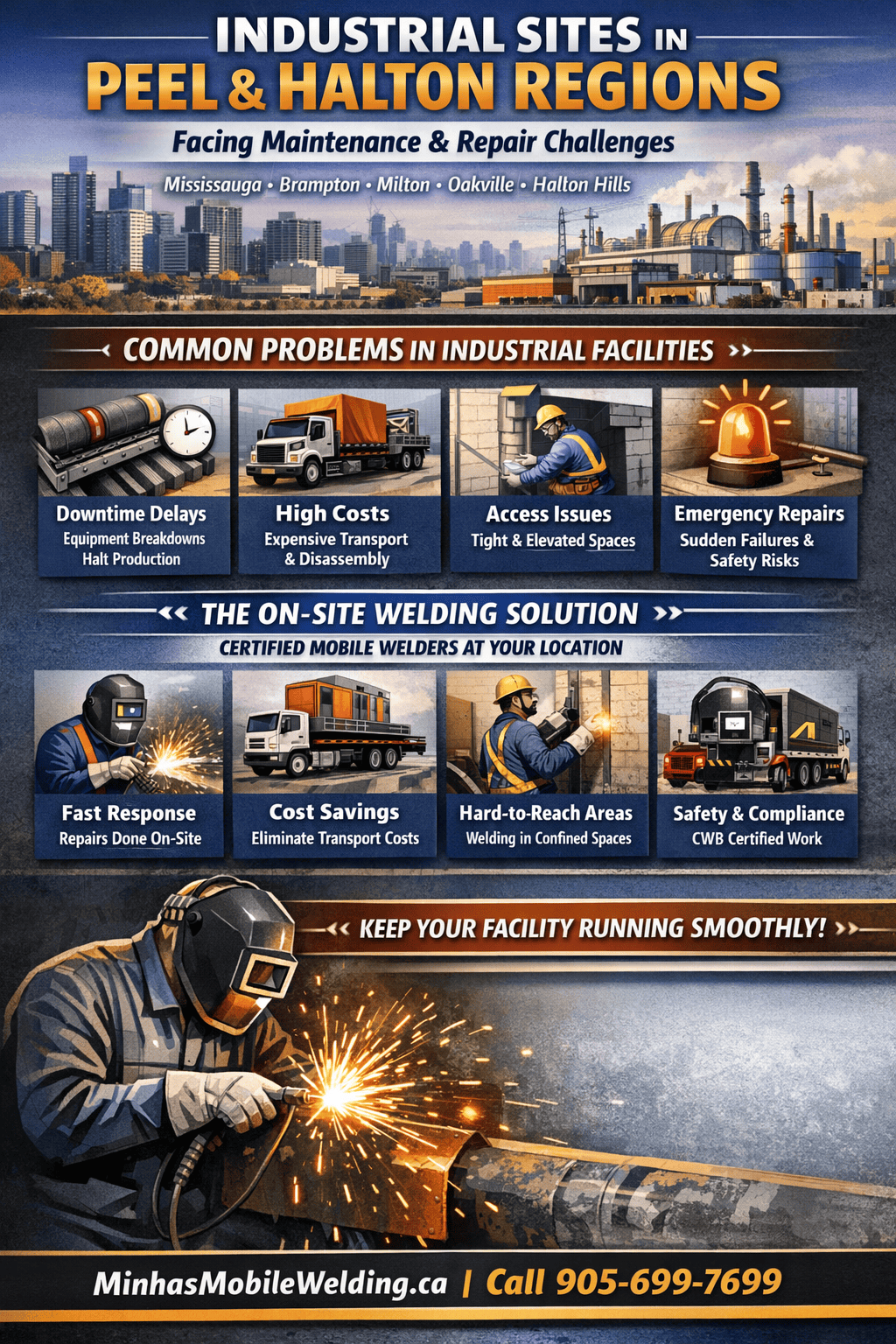
How On-Site Welding Provides Effective Solutions
On-site welding directly tackles these challenges by bringing skilled, equipped professionals and processes to the facility.
Minimized Downtime and Faster Turnaround Repairs
Repairs happen in place, often within hours rather than days. Industry insights show that proactive, on-site approaches—including mobile welding and related maintenance—can reduce unscheduled downtime by up to 30% in some sectors. For example, a manufacturing plant in Mississauga or a distribution center in Milton can have a welder address a broken conveyor support during a scheduled maintenance window or emergency shutdown, allowing production to resume quickly. This rapid response keeps operations moving and protects bottom-line performance.
Significant Cost Savings
Eliminating transportation and disassembly reduces labor, equipment rental, and logistics expenses. Businesses avoid the indirect costs of prolonged downtime, such as overtime for catch-up work or penalties from supply chain delays. In high-volume industrial zones like Halton Hills or Brampton, these savings accumulate meaningfully over time.
Flexibility for Complex or Inaccessible Repairs
Mobile units handle work in confined spaces, elevated platforms, or live facilities using portable equipment for processes like TIG, MIG, or stick welding on materials including steel, stainless steel, and aluminum. This adaptability suits the diverse needs of regional plants, from structural reinforcements in warehouses to pipe repairs in processing facilities.
Enhanced Safety and Compliance
On-site services allow real-time assessments and adjustments, ensuring welds meet Canadian safety standards and codes. Many providers in the GTA, including those serving Peel and Halton, offer CWB-certified welders who prioritize proper preparation, ventilation, and hazard controls. Immediate repairs to safety features, like guardrails or structural supports, help maintain workplace safety and avoid incidents.
Custom Modifications and Proactive Maintenance
Beyond fixes, on-site welding supports upgrades, such as adding reinforcements or fabricating custom brackets without disrupting the full operation. This proactive approach extends equipment life and prevents future breakdowns.
In Peel and Halton, numerous experienced mobile welding providers includng Minhas, serve these industrial corridors, offering 24/7 emergency response and specialized services for manufacturing, heavy equipment, and structural needs. Their presence reflects the region’s emphasis on efficient, localized support for its industrial ecosystem.
The Bottom Line
For industrial operators in Peel and Halton, on-site welding represents a practical, high-impact solution in an environment where every hour of uptime counts. By addressing downtime, costs, access issues, and compliance head-on, it enables facilities to maintain productivity, safety, and competitiveness. When equipment breaks or needs changes, hiring a mobile welder on-site is usually the fastest, smartest solution.
Frequently Asked Questions
What types of industrial work is on-site welding best suited for in Peel and Halton?
On-site welding excels for structural repairs, machinery fixes, pipe welding, conveyor modifications, safety railing restorations, and custom fabrications in factories, warehouses, and processing plants. It’s particularly valuable where components are too large, fixed, or disruptive to move.
How does on-site welding ensure high-quality results compared to shop welding?
Certified mobile welders use the same professional techniques and equipment as shop-based services, often with CWB certification. On-site work allows direct oversight, immediate adjustments, and real-time inspections, reducing risks from transport or delays.
Is on-site welding safe for active industrial facilities?
Yes, when performed by trained professionals who follow strict safety protocols—including proper ventilation, fire prevention, PPE, and hazard isolation. Many services prioritize minimal disruption and comply with Ontario regulations to protect workers and operations.
What should I look for when choosing an on-site welding service in the region?
Look for CWB-certified welders with industrial experience, 24/7 availability for emergencies, well-equipped mobile units, positive references from local facilities, and insurance coverage. Proximity to Peel and Halton ensures faster response times.
Can on-site welding handle emergency repairs outside regular hours?
Many providers in the GTA, including those serving Peel and Halton, offer emergency and after-hours service for urgent issues like equipment failures that threaten production or safety.